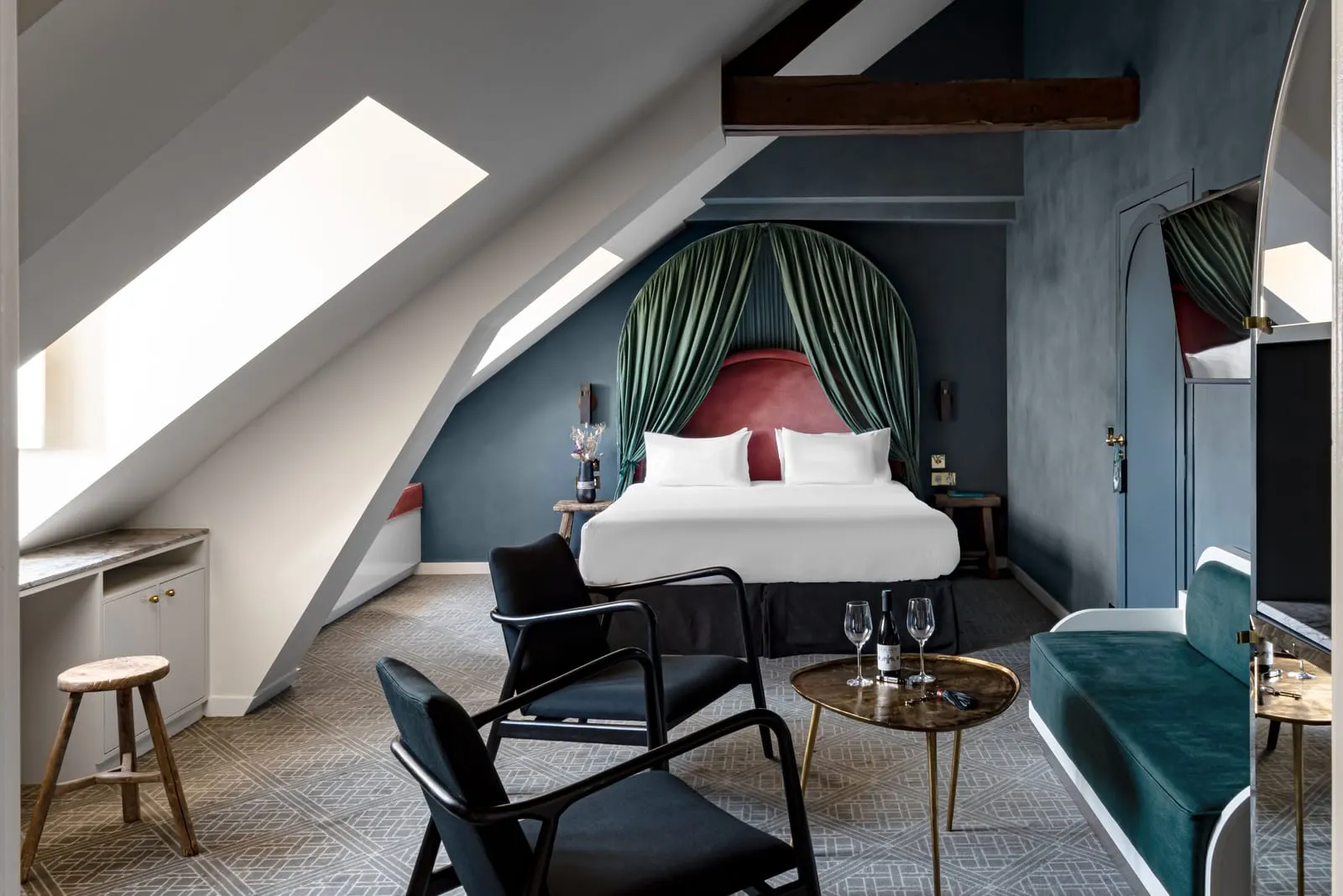
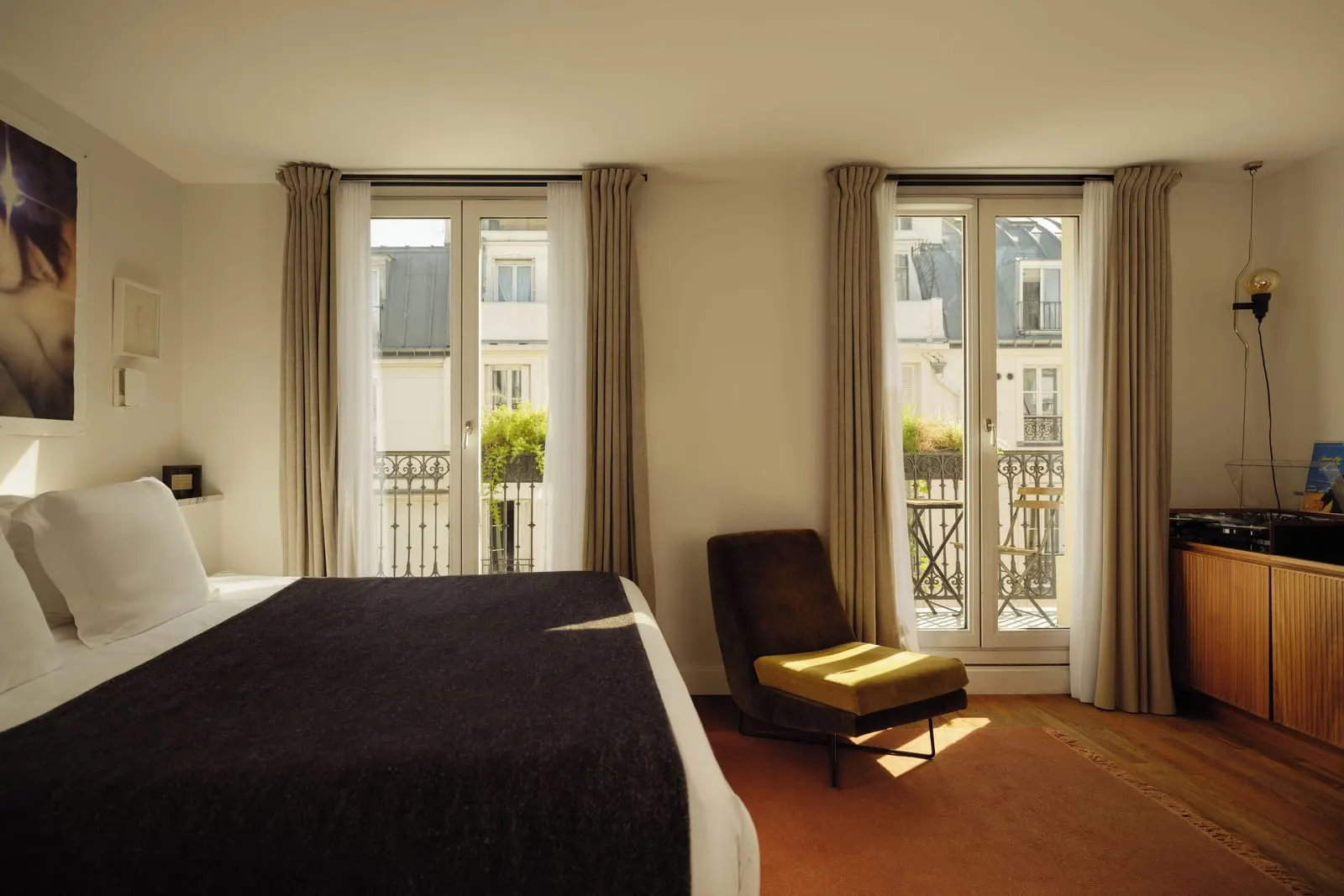
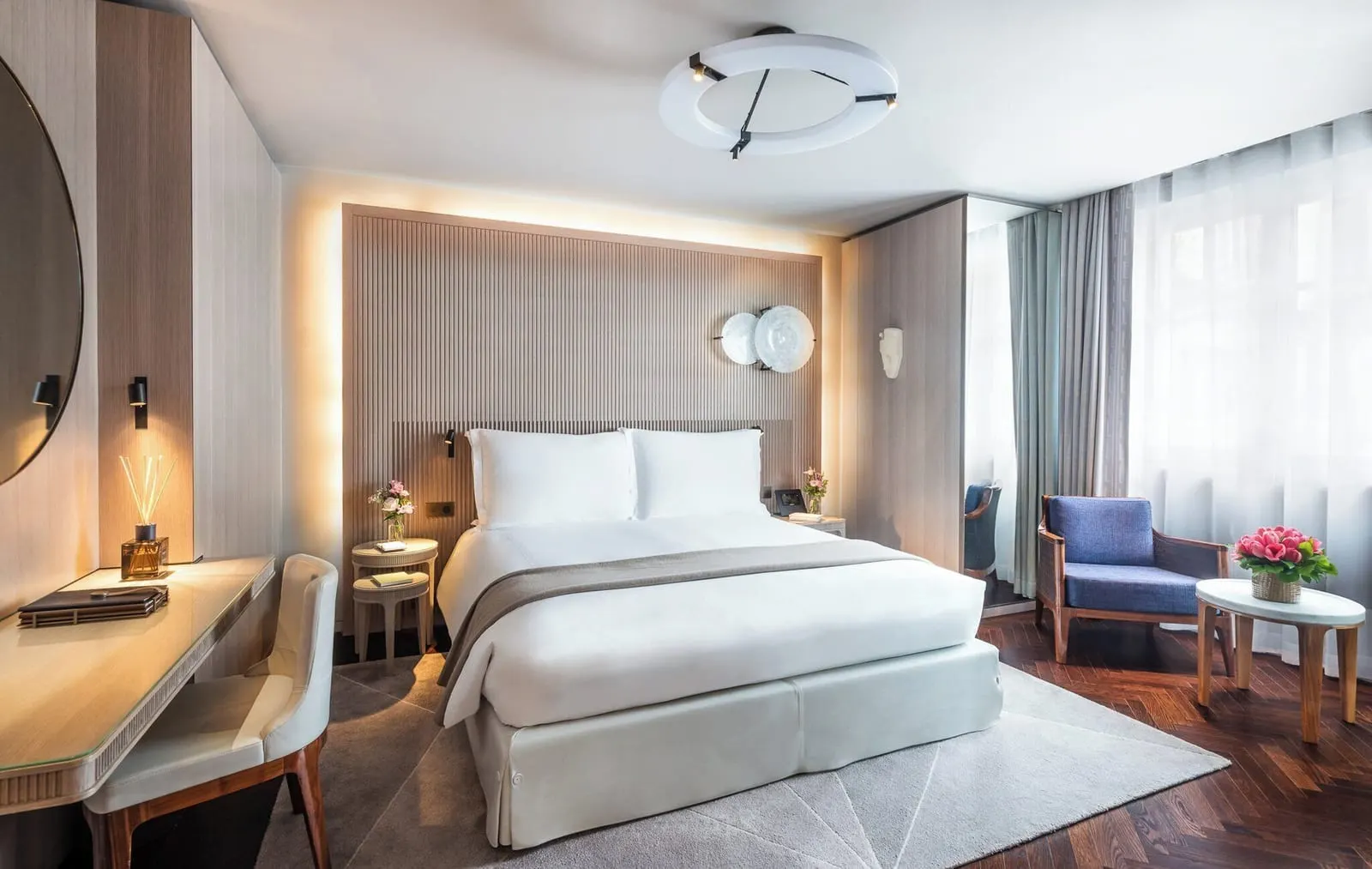
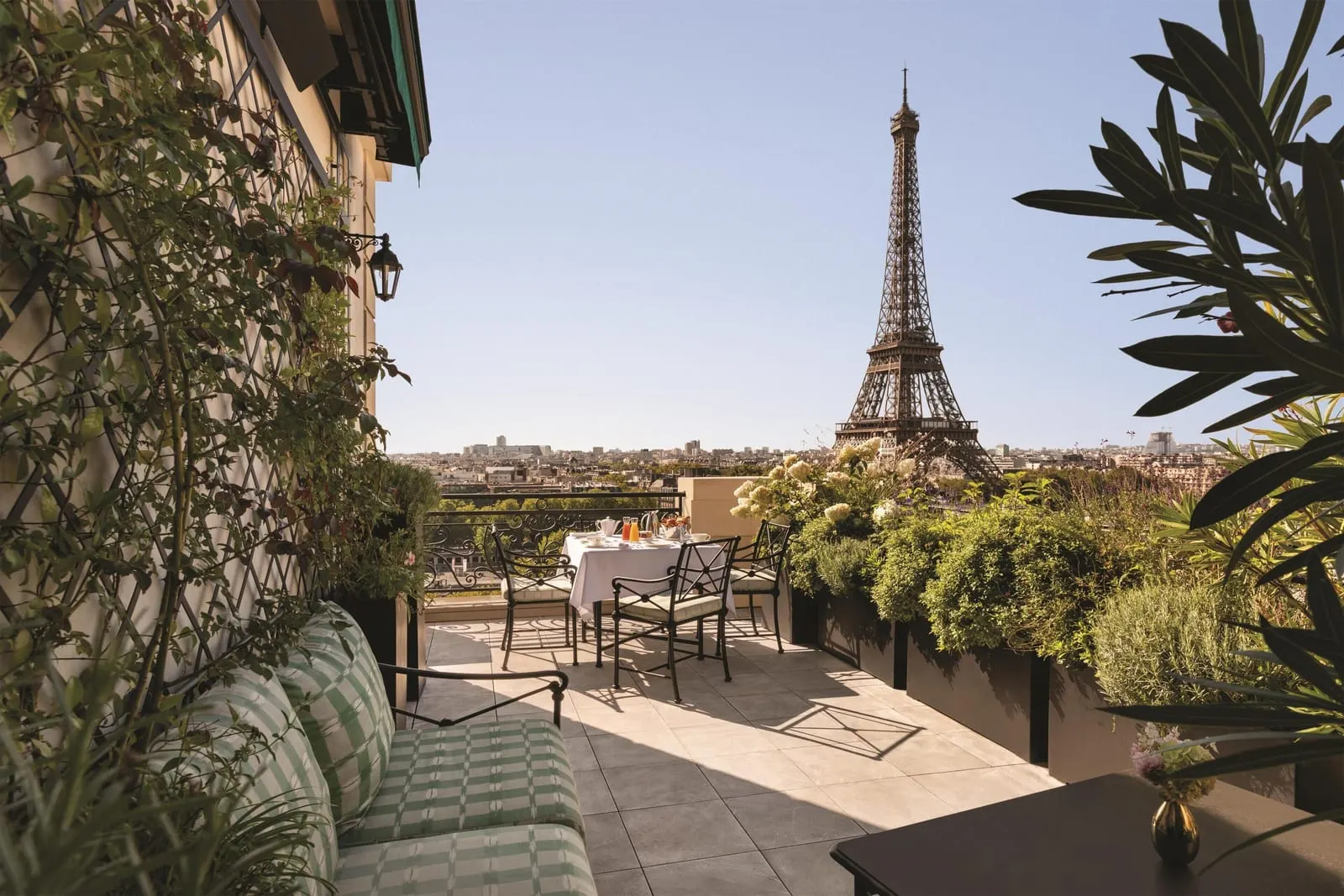
Two things decide the choice. At the smaller houses rooms run small, so the decoration matters more than the floor area: the entry double at Grands Boulevards Experimental is 15 m², and Le Grand Mazarin's Classic is 20 m². And at the big addresses much of the design is in the places every guest shares, the bars, restaurants and pools, whichever room you book. The seven run from about €260 a night in February at Grands Boulevards Experimental to about €2,190 at the Crillon.
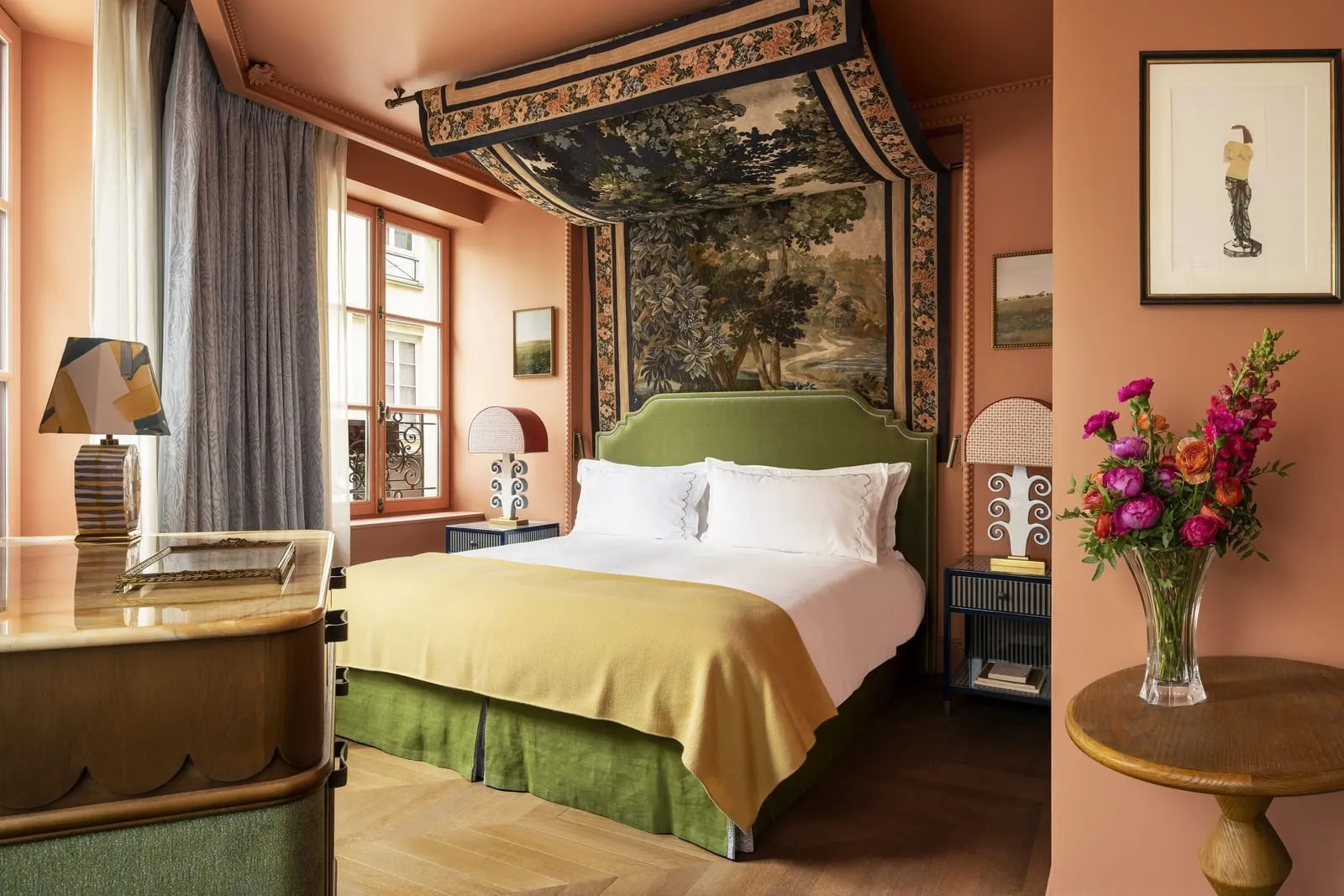
At Le Grand Mazarin the decoration is the reason to book. Martin Brudnizki, who designed Annabel's in Berkeley Square, built his brief around the literary salons of the Grand Siècle, and it shows in all 61 rooms. Each bed sits under a tapestry canopy that Art de Lys loom-wove in the Aubusson style, over chevron parquet, with fabrics from Pierre Frey, bronzes from Lucien Gau and rugs from Pinton. Two of those makers, Art de Lys and Pinton, carry the French state's label for living heritage crafts. Several categories add leopard-print armchairs.
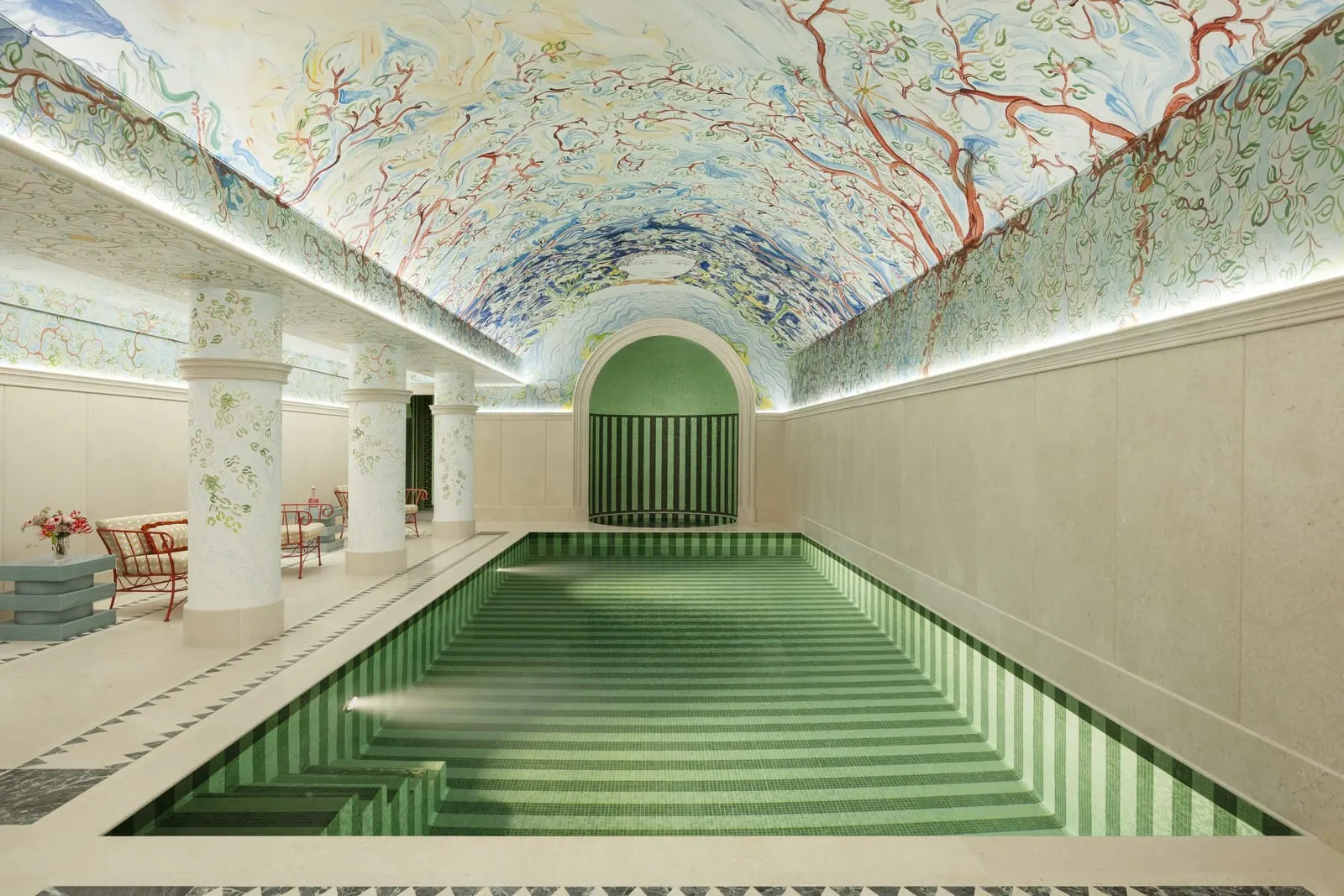
Downstairs is the photograph people know: an 8-metre mosaic pool for hotel guests, with a jacuzzi and a hammam beside it, beneath a vault on which Jacques Merle painted the story of Narcissus. Boubalé, the restaurant, carries on with painted ceilings and velvet, and the three old buildings that form the hotel wrap around a leafy winter garden. This is maximalism from the floor to the canopy.
The room to book
Deluxe Room
23 to 33 m²€684 a night
The cabinet-of-curiosities rooms, which add stripes and flea-market antiques to the canopy and parquet every room has: book it for the decoration rather than the space.
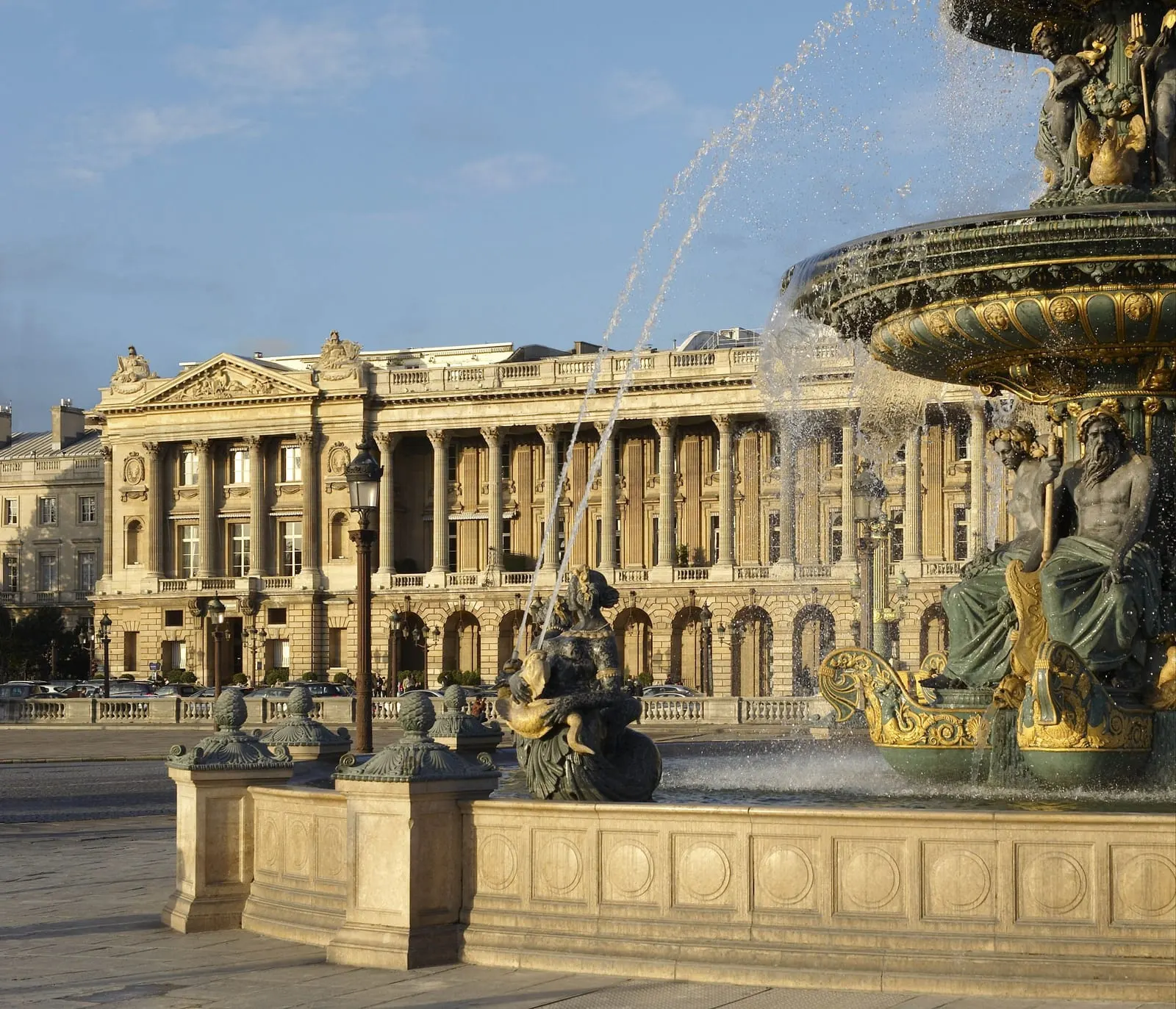
Hôtel de Crillon, A Rosewood Hotel earns its place with the building and the work done on it. It is the 18th-century townhouse that Louis-François Trouard began in 1775 at the western corner of Ange-Jacques Gabriel's façade on the Concorde. Upstairs, the Salon des Aigles and the Salon Marie-Antoinette were listed in 1964 and keep their original ceilings of 1775 to 1776, over six metres above the floor.
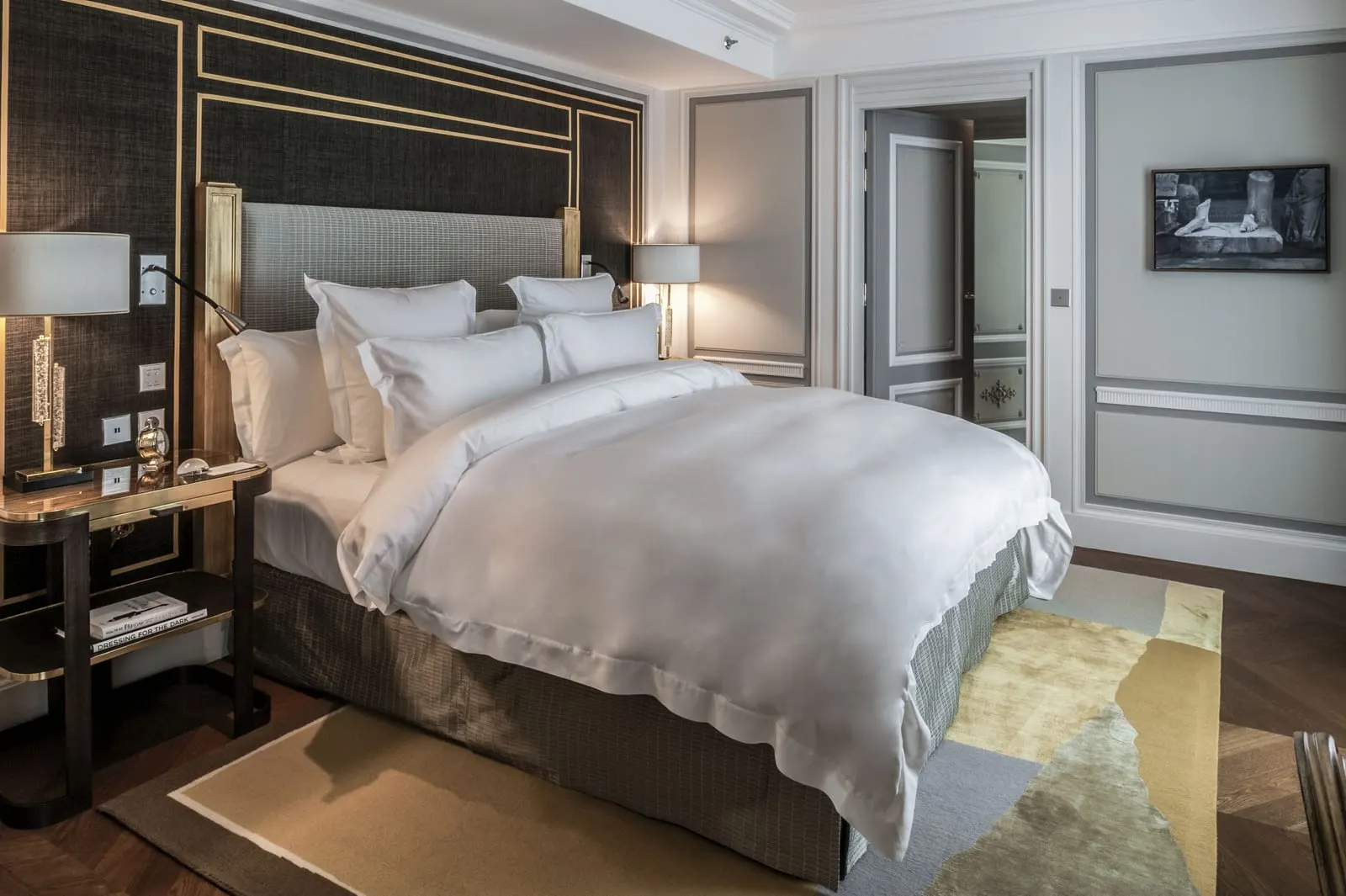
Richard Martinet's four-year restoration ended in 2017, and the modern layer is as strong as the old. Karl Lagerfeld furnished the two Grands Appartements to his own designs, and the bath in one was carved from a single block of Carrara marble weighing more than two tonnes. Bar Les Ambassadeurs, once the gourmet dining room, now pours cocktails under a painted ceiling. Beneath the Cour Gabriel the pool runs under a glass roof between Peter Lane's blue ceramic walls, over a floor of 17,600 pieces of gold mosaic.
The room to book
Grand Premier Room
about 42 m²€2,655 a night
About 42 m² against the entry Deluxe Room's 32, with the marble bathroom and soaking tub every room has, and space to sit in a house you are booking for the building.
Take a drink on the Bar Les Ambassadeurs terrace, under the arcades of the square: it opens daily at 5pm and takes no reservations, so arrive early for a table.
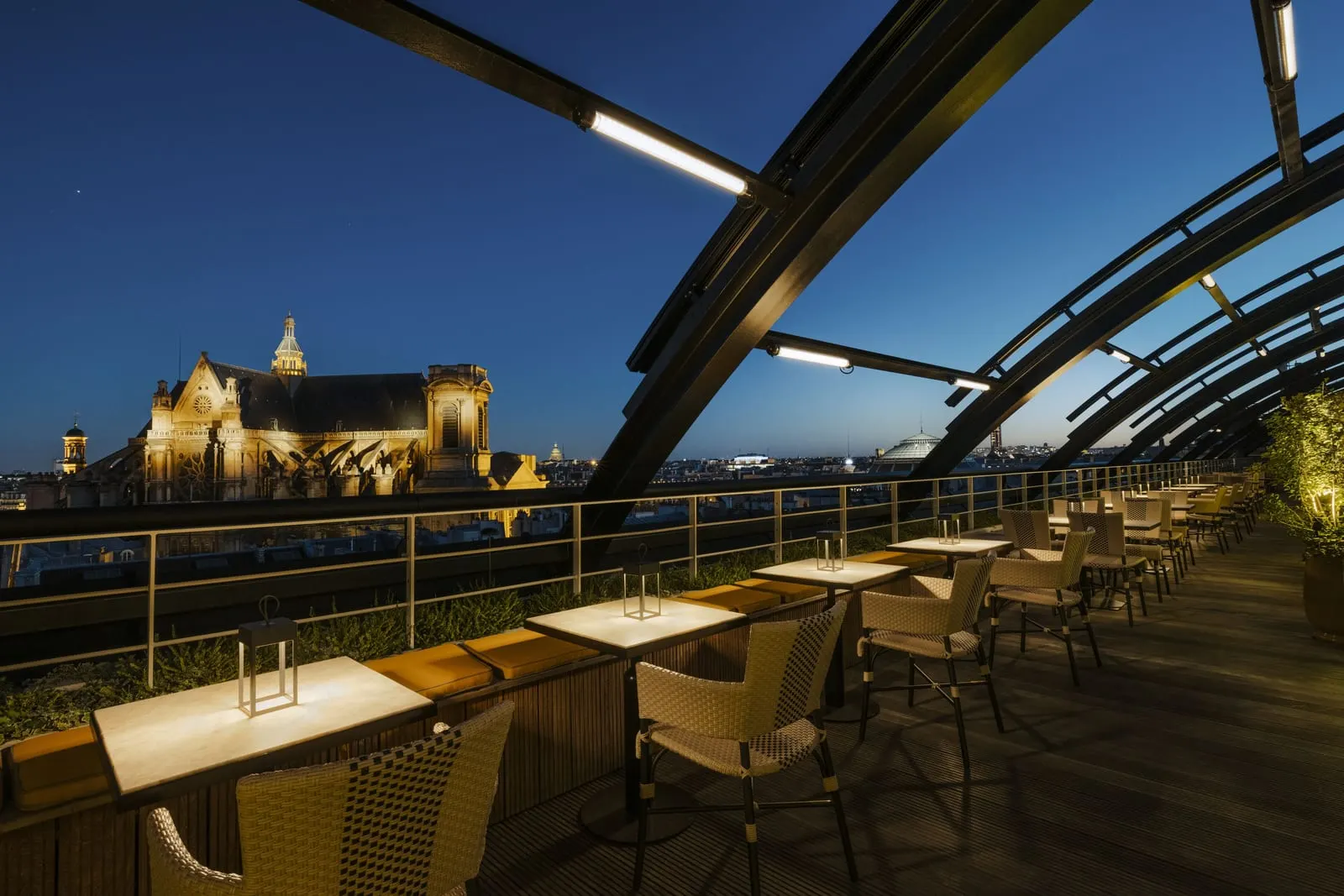
Hôtel Madame Rêve gives a working landmark a second life. Julien Guadet built the Louvre post office around a monumental iron frame inside cut-stone walls, and it opened in 1888. Dominique Perrault's conversion, begun in 2016, opened the courtyard to the sky and capped the top floor with new glass. The hotel followed in 2021, its rooms done by Laurent Taïeb with the designer Bruno Borrione in golden-brown wood and made-to-measure fabrics, with mosaic in the bathrooms and post-office motifs in the art and on the carpets.
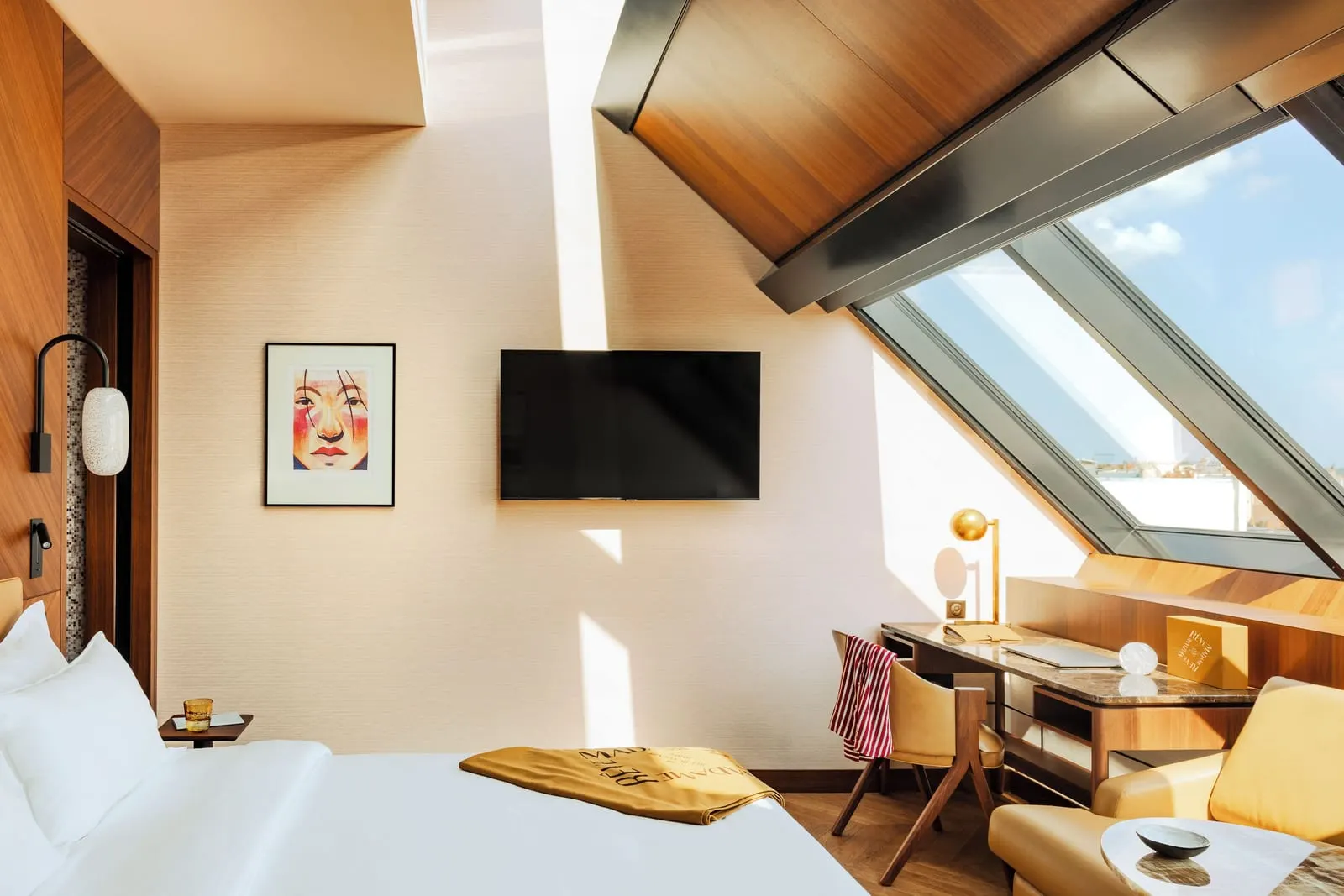
The design works because nothing is kept as a museum piece. The post office still serves customers downstairs, a hanging garden fills the courtyard, and on the top floor sloping atelier windows look across the zinc roofs. On the roof itself, ROOF's planted garden faces Saint-Eustache and the Panthéon and serves until 1am in every season, with a covered, heated patio in winter.
The room to book
Deluxe Atelier, Paris View
30 to 35 m²€671 a night
30 to 35 m² on the top floor, behind the sloping atelier windows that are the building's signature, looking across the zinc roofs of the 1st rather than into the courtyard.
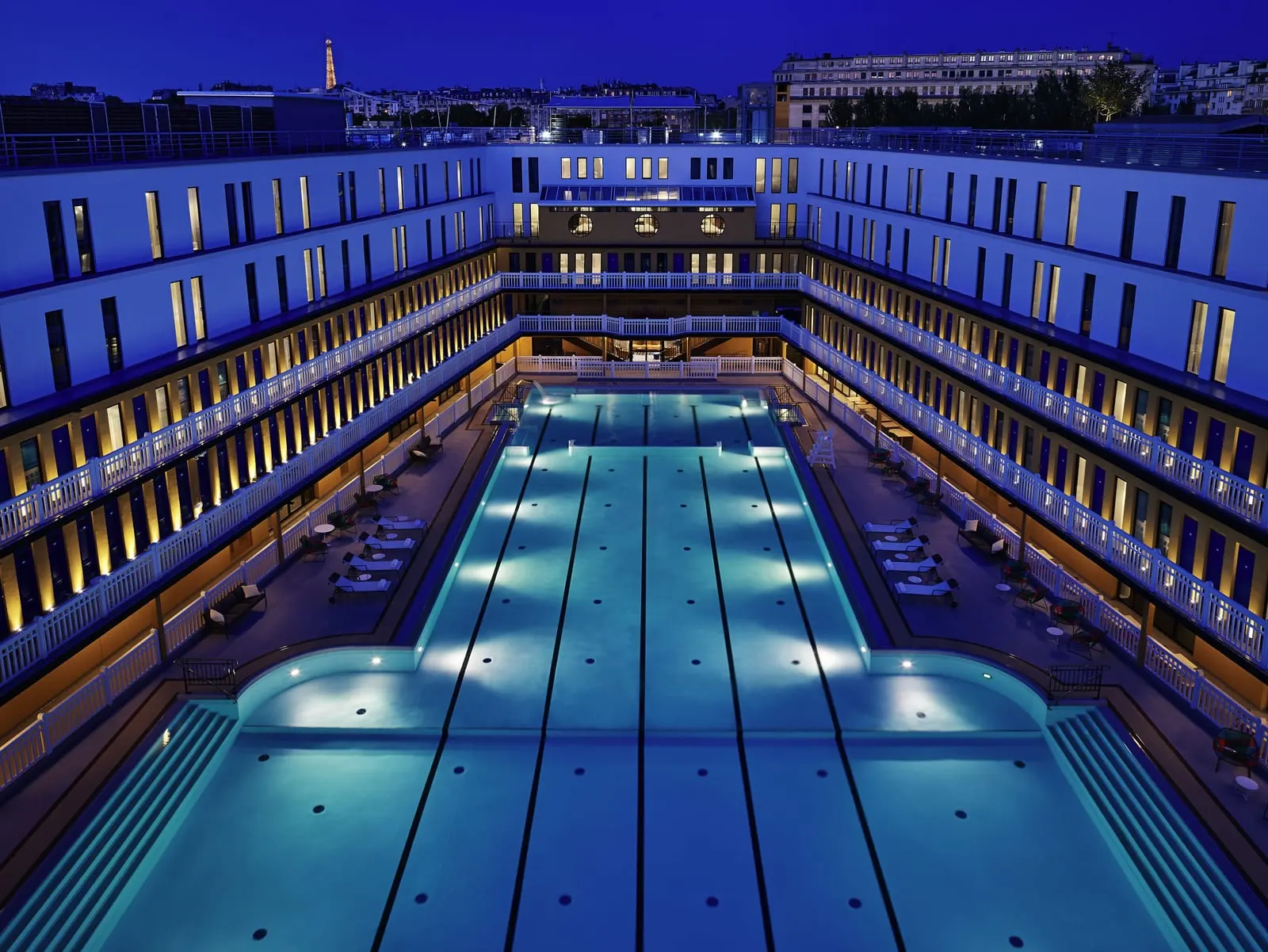
Hôtel Molitor Paris is built around Lucien Pollet's 1929 Art Deco baths, or rather a close copy of them. The concrete was judged past saving, and in 2012 nearly everything came down except the entrance on Avenue de la Porte Molitor and part of Louis Barillet's 1929 stained glass. The pools and their galleries of cabins were built again to the old design, with new floors of rooms above, so the whole block feels like a liner's deck.
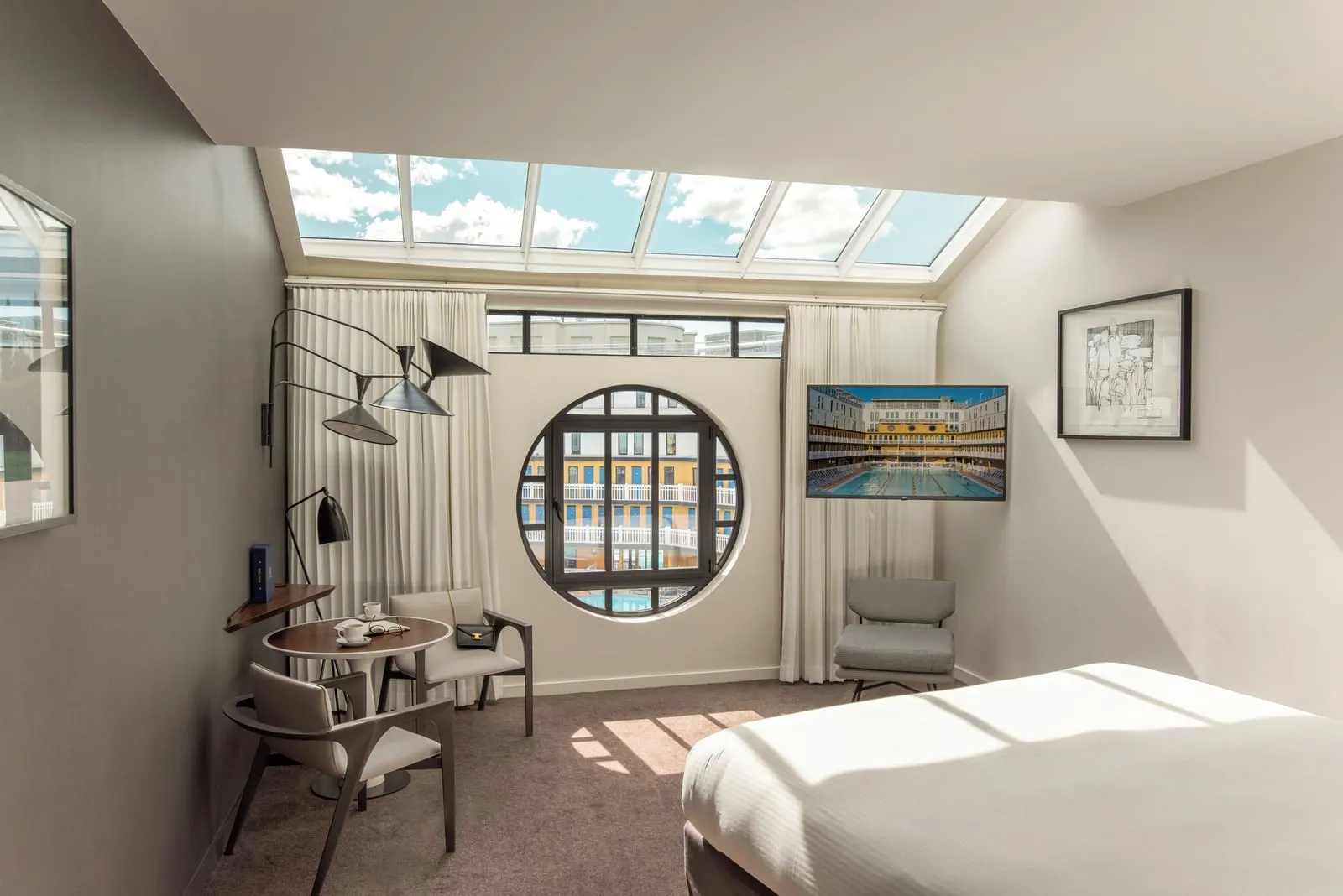
Outside, the 46-metre pool sits inside rows of blue cabin doors. Indoors, the 33-metre pool lies under a glass roof, and street artists have painted the 70 cabins around it, as they once painted the empty baths after they closed in 1989. Jean-Philippe Nuel designed the interiors, and in one version of the Executive a round porthole frames the outdoor pool. Both pools are heated, access to at least one is guaranteed all year, and swimming comes with the room.
The room to book
Executive Room with Iconic Porthole window
about 30 m²€761 a night
The hotel's signature room, about 30 m² with a glass roof overhead and the outdoor pool framed in a round porthole window; it has a shower rather than a bath.
Grands Boulevards Experimental gives every room a designer's touch at a lower rate than anywhere else on this list. Dorothée Meilichzon used one vocabulary for all 50: beds under a curtain canopy above a velvet headboard, walls finished in lime plaster, and old linen, worn wood and aged bronze. The 18th-century building sits back from Boulevard Poissonnière behind a terrace, reached by a long side passage, and holds one MICHELIN Key.
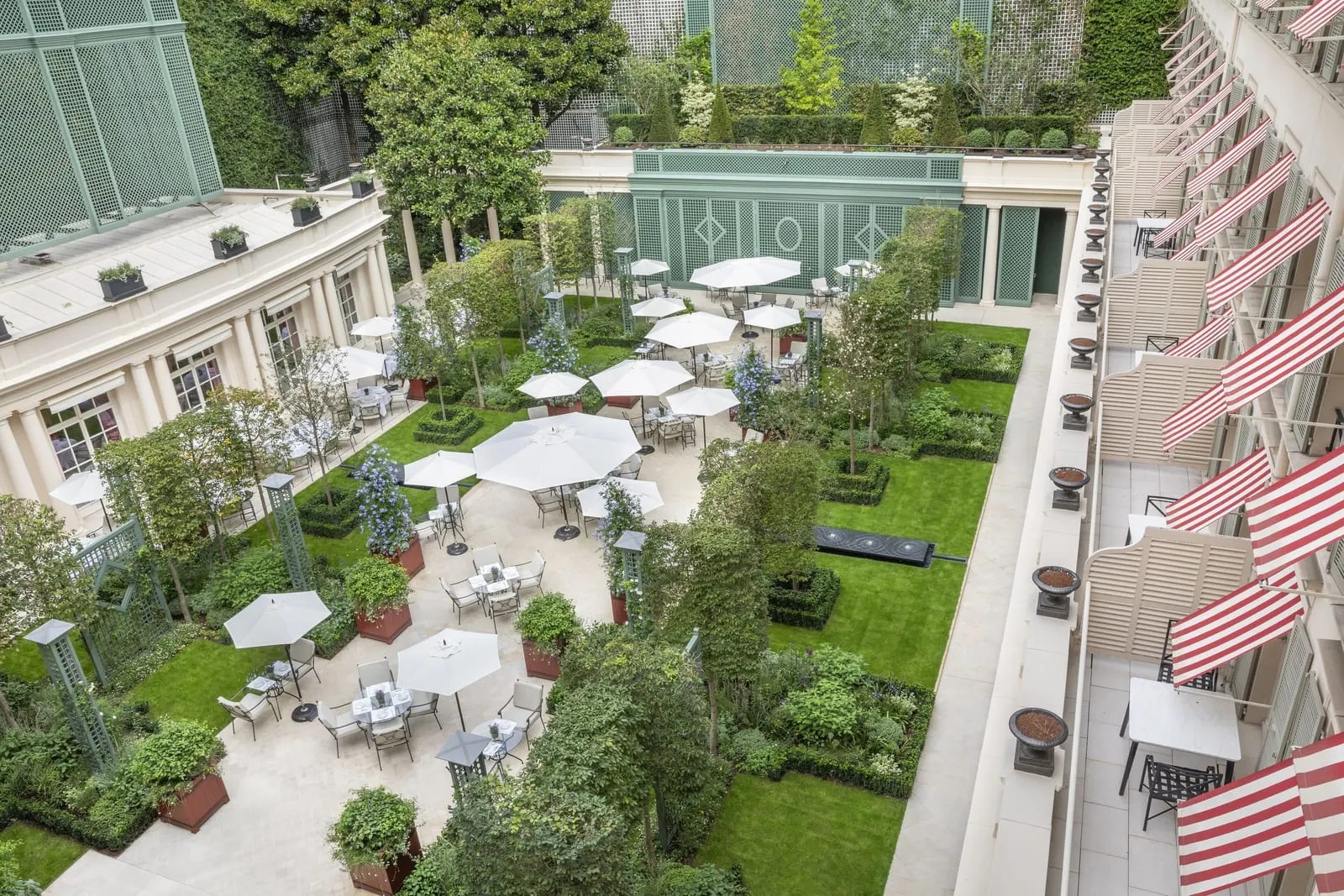
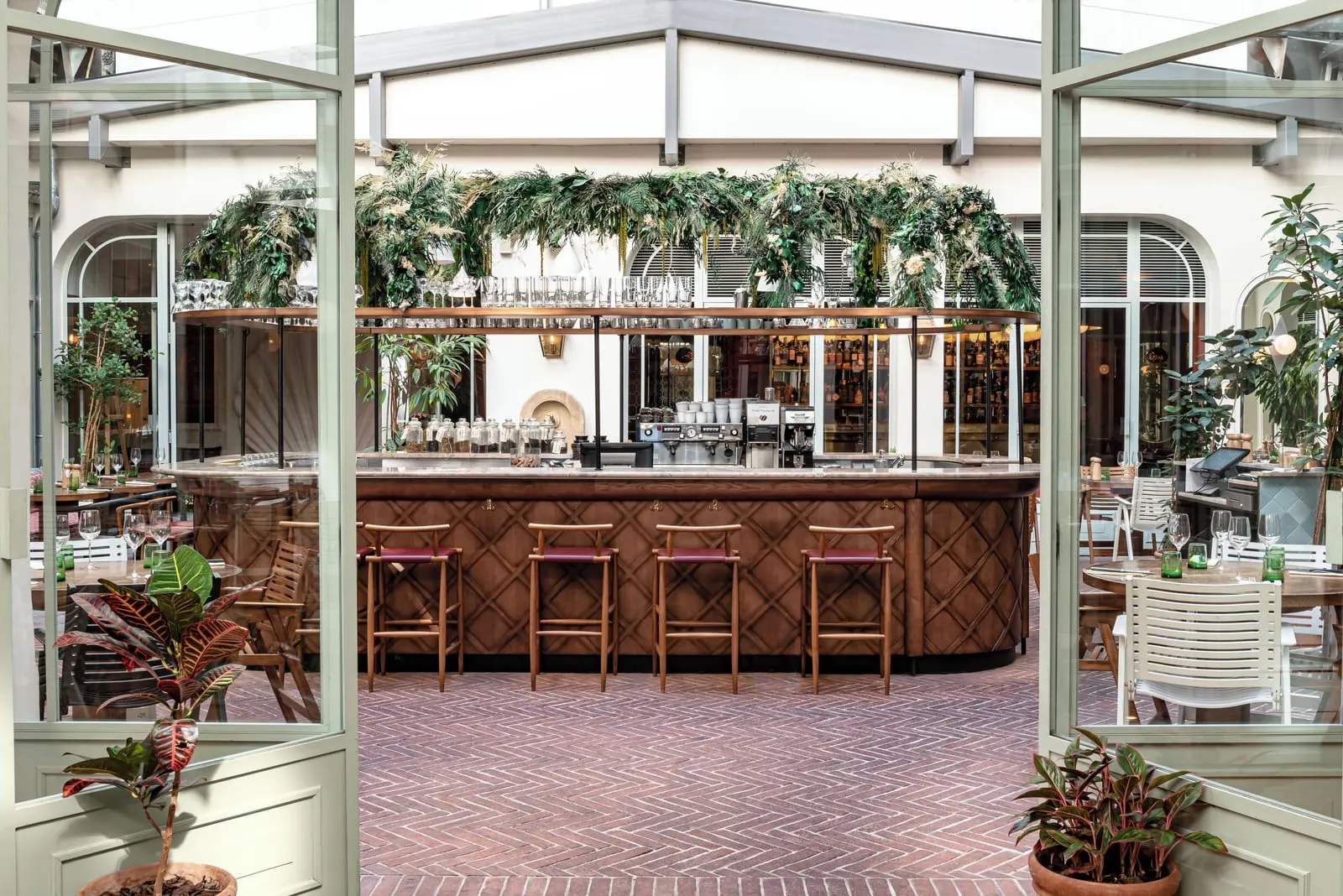
Downstairs is designed as carefully as the rooms. The restaurant fills the courtyard around a central bar, under glass that opens in warm weather. From October to March, The Shell opens on the ground floor: copper, rust-coloured walls, velvet seats and shells, Meilichzon's nod to Marie Antoinette's taste for shells and mosaics. On the roof, The Shed is a small planted bar, open every evening of the year.
The room to book
Parisian Eaves
about 23 m²€396 a night
Meilichzon's canopy and lime plaster under exposed wooden beams and a skylight on the top floor: 23 m² with a bathtub for two or a large shower.
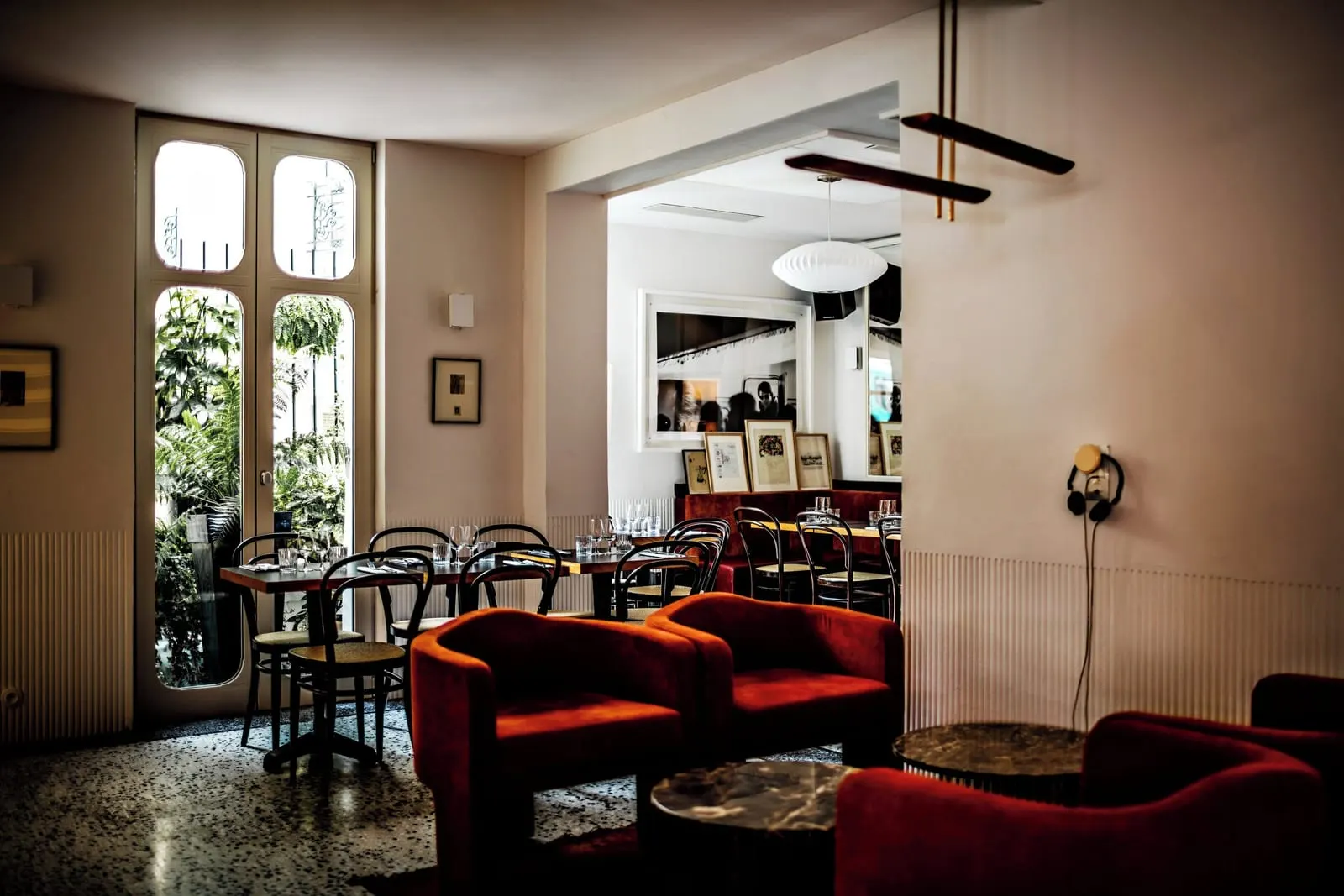
Le Pigalle wears its neighbourhood. Festen Architecture started from classic Parisian details, panelled doors, mouldings and parquet, then took its materials from the street: terrazzo like the floors of the local bars, the humble veined marble of the old faubourg, and leopard and oxblood in the lift as a wink to the old brothels. Books and vintage furniture turn up in all 40 rooms, and the prints on the walls are by photographers who have long worked these streets.
The ground floor is the neighbourhood's living room as much as the hotel's: café, restaurant and bar together, with a record library, a kiosk of papers and books, and DJs in the evening. Upstairs the records continue: Pigalle 12, Pigalle 21 and the suite each have a turntable and records of their own, and in the Pigalle 21 rooms the selection was made by Victor Kiswell, a collector raised in Pigalle.
The room to book
Pigalle 21
about 21 m²€339 a night
The first double with a turntable, a bar cabinet and records chosen for that room by Victor Kiswell, with two basins and 21 m².
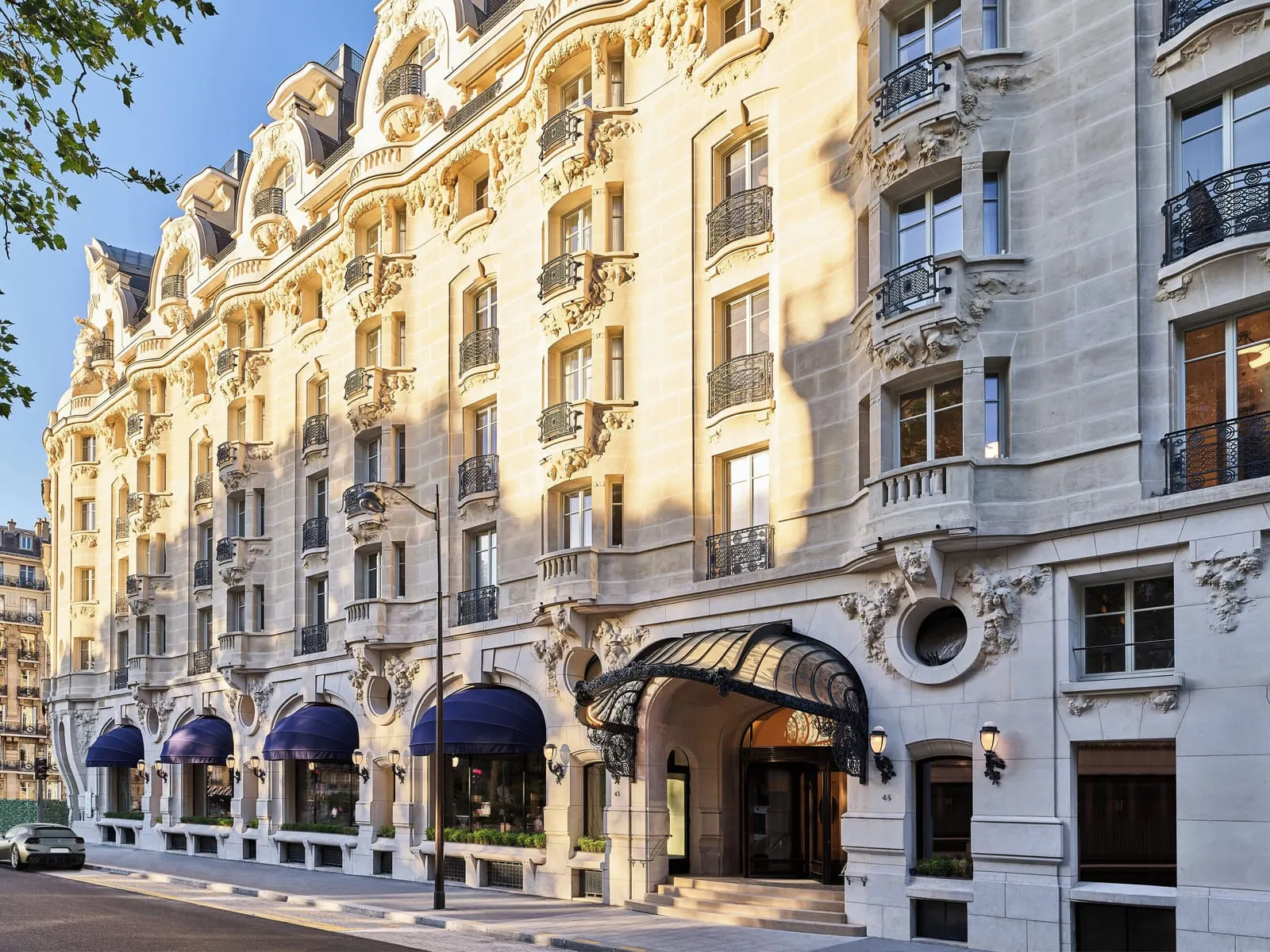
Mandarin Oriental Lutetia, Paris holds two styles in one building. Le Bon Marché put it up in 1910 on Boulevard Raspail, with an Art Nouveau stone front carved with vines, and the interiors turned Art Deco in the 1920s. The façades, roofs and main salons were listed in 2007, and Jean-Michel Wilmotte's restoration, begun in 2014, reopened the hotel in 2018.
The first four room categories share one finish: Murano glass wall lights, tinted oak underfoot and Carrara marble in the bathroom. The shared rooms hold the history. Bar Joséphine's frescoes were uncovered from under layers of paint and restored for the reopening, and Le Saint-Germain has Fabrice Hyber's painted glass roof overhead. Two signature suites go further: the Haute Couture Suite, which Wilmotte designed with Isabelle Huppert, and a rooftop penthouse furnished with pieces from Francis Ford Coppola's collection.
The room to book
Grand Superior Room
about 33 m²€1,472 a night
The same Murano glass, tinted oak and Carrara marble as the rooms above it, at the entry rate, looking onto the Art Deco patio at the heart of the building.
Shangri-La Paris is Prince Roland Bonaparte's 1890s house, whose façades, grand staircase and salons are a listed monument, with Pierre-Yves Rochon's rooms in blues, ecru, gold and marquetry and Le Bar Botaniste done up as a Napoleonic tent.
Le Bristol Paris has a sixth-floor indoor pool that the naval architect Cäsar Pinnau laid out as the teak deck of a 1920s yacht, rooms furnished in Louis XV and Louis XVI style, and Arabella Lennox-Boyd's 1,200 m² garden at the heart of the house.
From about €1,790 a night
Questions people ask
Good questions about Paris
Which Paris hotels were designed by well-known interior designers?
Hôtel de Crillon, A Rosewood Hotel is the 18th-century townhouse on the western corner of Gabriel's façade on the Place de la Concorde; it has been a hotel since 1909, and two of its salons were listed in 1964. Mandarin Oriental Lutetia, Paris was built in 1910, and its façades, roofs and main salons were listed in 2007. Hôtel Madame Rêve occupies the upper floors of Julien Guadet's Louvre post office, in service from 1888, and the post office still trades downstairs. Grands Boulevards Experimental is in an 18th-century building set back from Boulevard Poissonnière.
Is the pool at Molitor the original 1929 pool?
No. The Molitor baths opened in 1929 and closed in 1989, and in 2012 almost all of the building was demolished, because the concrete was judged past saving. The pools and the cabin galleries around them were built again to the old design, with new floors of hotel rooms above, and Hôtel Molitor Paris opened in 2014. The outdoor pool is now 46 metres long, four metres shorter than in 1929, and the indoor pool 33 metres, under a glass roof. Both are heated, access to at least one is guaranteed all year, and swimming comes with the room.
Independently, through extensive research, trusted sources and first-hand visits. Hotels cannot pay to be included, and every one of the ten has to exist for a different reason.
 The design one