Skip to content
The Better Trip

Destinations

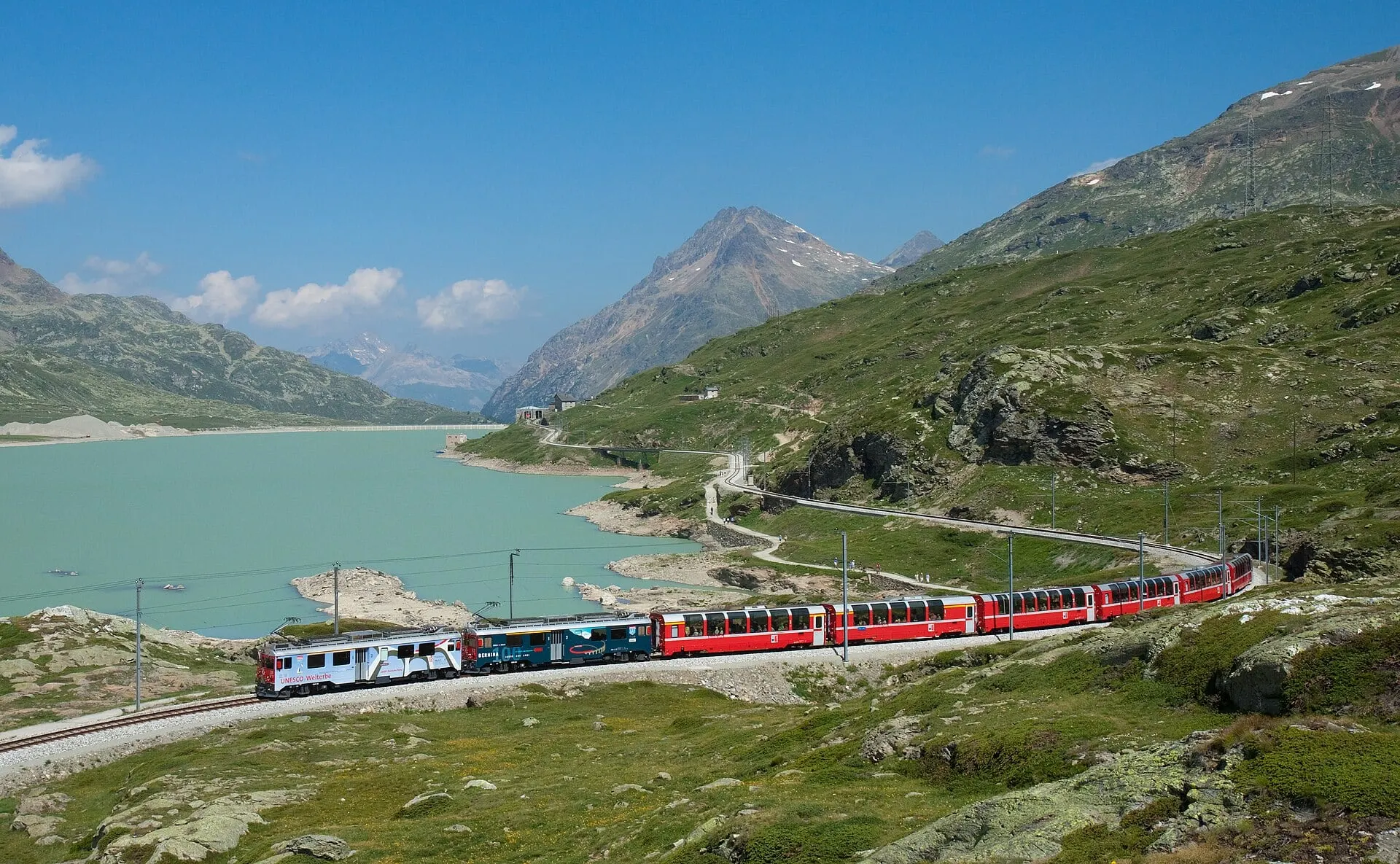
The Bernina Express passing the turquoise Lago Bianco under a blue sky, with Ospizio Bernina station in the background.

TrainWinterSummer

Chur to Tirano on the Bernina Express, over the Alps to Italy

Over the Landwasser Viaduct, past glaciers at 2,253 m, round a stone spiral and down to the palms of Tirano.

The short answer

The Bernina Express takes 4 hours 32 minutes from Chur to Tirano on the daily 08:17 (arriving 12:49 in the 2026 timetable) and about 2 hours 15 minutes from St. Moritz. In summer 2026 five panoramic trains a day ran each way, two of them from Chur; from 26 October, two a day each way, three at weekends. You pay the ordinary ticket, CHF 66 second class from Chur or CHF 33 from St. Moritz, plus a compulsory seat reservation of CHF 40 to 44 from Chur or CHF 32 from St. Moritz. Regional trains cover St. Moritz to Tirano almost every hour on the ticket alone, with an optional CHF 5 seat.

In a single morning the railway climbs from Chur to a lake beside the glaciers at 2,253 m, then drops through 70 per mille gradients, without a rack, to the vineyards and church towers of Tirano in Italy. It is the highest railway across the Alps that runs all year, and UNESCO lists both of its lines, the Albula and the Bernina, as World Heritage. Take the red panoramic Bernina Express, or ride the same rails on the hourly regional trains with the windows open.

Switzerland · Italy

Journey time
4 h 32 min on the 08:17 from Chur; about 2 h 15 min from St. Moritz
Highest point
2,253 m at Ospizio Bernina, beside Lago Bianco
Steepest gradient
70 per mille (7%), without a rack
Bernina Express a day
5 each way in summer 2026; 2 from 26 October, 3 at weekends
Fare from
CHF 65 St. Moritz to Tirano, ticket and seat (2026)
Engineering
196 bridges and 55 tunnels from Chur

Why this is one of the great railway journeys

Two railways built in the first decade of the 20th century make up this journey. The Albula line, opened from Thusis to St. Moritz in 1904, climbs into the Engadin on curving stone viaducts and spiral tunnels and passes under the Albula massif at about 1,800 m. The Bernina line, through from St. Moritz to Tirano since 1910, was built from the start as an electric railway and goes straight over the pass at gradients of up to 70 per mille, which makes it one of the steepest adhesion railways in the world. Its power still comes from the hydroelectric plants of the Valposchiavo, built alongside it.

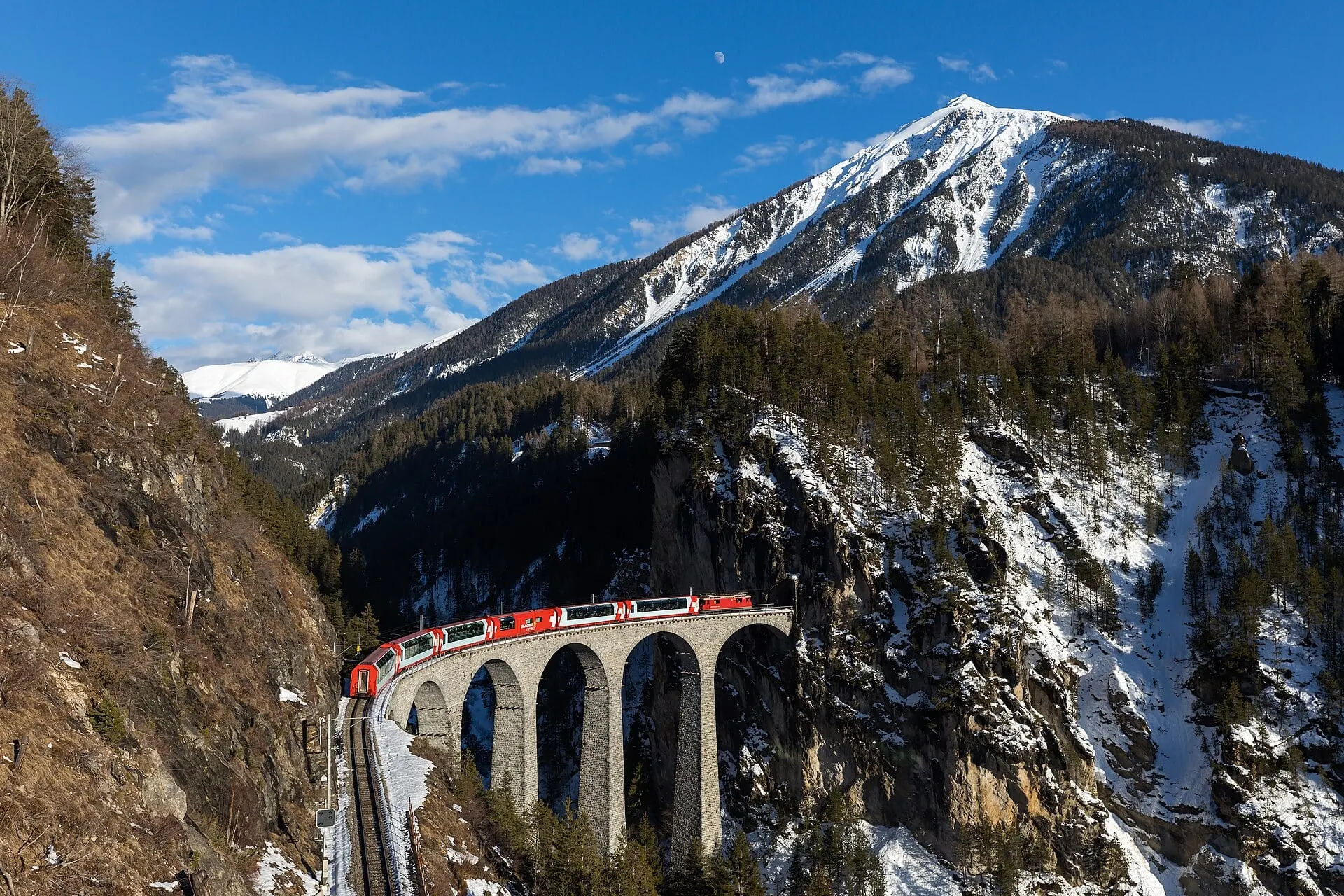
In 2008 UNESCO inscribed the two lines together as the Rhaetian Railway in the Albula/Bernina Landscapes, noting how harmoniously they blend into the Alpine landscape. From Chur the Bernina Express crosses 196 bridges and runs through 55 tunnels. The Landwasser Viaduct, 65 m high and curving straight into a cliff, is the most photographed thing on the network.

The Bernina Express itself began on 3 June 1973 as a through train from Chur, the first time the railway had marketed a route to tourists. Its panoramic cars, with glass that curves up into the roof, carried 416,220 people in the first ten months of 2025 alone. What they come for is the change in a single day: from Chur, the oldest town in Switzerland, through gorges to ice and bare rock at the pass, then down to a lake, a spiral bridge and the palms of Tirano, where the train runs along the street between the houses.
Along the way

  1. Chur
  2. between Tiefencastel and Filisur, about 70 minutes from Chur

    The Landwasser Viaduct

    Six stone arches 65 m above the Landwasser, built between March 1901 and October 1902 without outside scaffolding. The 142 m viaduct swings round on a 100 m radius and runs straight into the Landwasser tunnel in the cliff face. From the right-hand windows heading south you watch the front of the train go into the rock.

  3. Bergün to Preda, then the Albula Tunnel

    The spirals above Bergün

    Between Bergün at 1,373 m and Preda at 1,789 m the line climbs more than 400 m in loops, viaducts and helical tunnels. At Preda it enters the Albula Tunnel at about 1,800 m: the original bore of 1903 was the highest railway tunnel in the Alps, and since 2024 trains use a new 5.86 km tunnel beside it.

  4. after Pontresina, around Morteratsch

    The Morteratsch Glacier and the Montebello curve

    Climbing Val Bernina from Pontresina, the line swings round the Montebello curve with the Morteratsch Glacier opening up to the south, under the Bernina range and the highest summit in Graubünden. Sit on the right going south to have it on your side.

  5. the summit, 35 minutes from St. Moritz on the Bernina Express, about 45 minutes on the regional RE9

    Ospizio Bernina and Lago Bianco

    The highest station of the line, at 2,253 m, stands on the shore of Lago Bianco on a plateau about 4 km long, with Lej Nair just to the north and the glaciers of Piz Cambrena above. The station and the stone hospice were built when the line was extended in 1910. Southbound, the lake fills the right-hand windows.

  6. the first stop over the pass, 2,091 m

    Alp Grüm and the Palü Glacier

    The whole Valposchiavo opens below the station, reaching away into Italy, with the Palü Glacier hanging to the west. Southbound Bernina Express trains stand here for 9 to 16 minutes in the 2026 timetable, time to step out. The stone station of 1926 is a restaurant and small hotel.

  7. after Poschiavo, past Le Prese and Miralago, then below Brusio

    Lago di Poschiavo and the Brusio spiral viaduct

    After Poschiavo the line runs along the western shore of Lago di Poschiavo, on the left heading south. Below Brusio comes the line's strangest structure: a stone viaduct built in 1907 and 1908 that turns a full circle in the open air instead of inside the mountain, so the train passes under its own track to lose height in a narrow valley at 70 per mille.

  8. the last 800 m

    Through the streets of Tirano

    Over the border the train slows to 15 km/h and runs along the street through Tirano for about 800 m, between the houses, to the terminus at 429 m: the lowest point of the whole Rhaetian Railway, and the town of palm trees at the end of the line.

  9. Tirano

Which side to sit

Going south from Chur or St. Moritz, sit on the right; coming north from Tirano, sit on the left. That side has the inside of the curve on the Landwasser Viaduct, so you see the train enter the cliff, then the Morteratsch Glacier, Lago Bianco at the summit and the Palü Glacier at Alp Grüm. The left side heading south gets Lago di Poschiavo, and the Brusio spiral shows itself from both sides as the train turns. On the Bernina Express the windows curve up into the roof, so both sides see the peaks; the reservation sets your seat. On the regional trains seats are unreserved unless you pay the optional CHF 5, so you can choose a side as you board, and the windows open for photographs.

Ways to do it

When to go

Tickets and reservations

How much is the Bernina Express, and do you need a reservation?

The Bernina Express needs two things: an ordinary ticket and a compulsory seat reservation, which you can buy together from Rhaetian Railway (RhB) or SBB. The reservation is per train, whatever part of the route you ride, and it is compulsory. Swiss travel passes, the Half Fare card, the GA, and Eurail and Interrail passes all cover the ticket, but everyone, children included, pays the reservation in full. Children under 6 travel free and from 6 to 16 at half fare.

Tickets go on sale six months ahead. Reservations open for a whole timetable year at once, usually between mid and late October for the year that starts in December, and popular dates sell out well ahead. Inside six days of travel, RhB sells last-minute second-class returns, ticket and seat together, on selected trains, which cannot be changed or refunded.

The regional trains between St. Moritz and Tirano need only the ticket. Since December 2025 you can reserve a seat on them for CHF 5, which RhB recommends on busy days; once the reservable seats are gone you can still travel, though at busy times you may have to wait for a later train.

Ticket Chur to Tirano
CHF 66 second class, CHF 113 first (one way, 2026)
Ticket St. Moritz to Tirano
CHF 33 second class, CHF 57 first
Bernina Express seat, Chur to Tirano
CHF 40 (14 December 2025 to 1 May 2026 and 26 October to 12 December 2026); CHF 44 (2 May to 25 October 2026)
Bernina Express seat, St. Moritz to Tirano
CHF 32 all year
Last-minute return, second class
CHF 87 from St. Moritz, CHF 105 from Chur, ticket and seat; online only, 6 days or less ahead; not on the Chur trains 951 and 952 in summer
Regional train seat
optional, CHF 5 per person and journey; individual seats cannot be booked for April 2027
Children
under 6 free; 6 to 16 half fare; reservation always full price

Timetable and journey times

How long is the Bernina Express, and how many trains a day?

From Chur the 08:17 Bernina Express takes 4 hours 32 minutes, calling at Thusis, Tiefencastel, Filisur and Bergün on the Albula line, then Pontresina and Bernina Diavolezza, a stop of 9 minutes at Alp Grüm, then Poschiavo and Le Prese. The other Chur trains take 4 hours 7 to 26 minutes. From St. Moritz it takes 2 hours 14 to 30 minutes. The regional trains run the Bernina line almost every hour: the faster RE9 in 2 hours 12 minutes, the R19, which stops everywhere, in 2 hours 35. From Chur by regular train, change at Samedan and Pontresina; the whole trip takes 4 hours 2 to 25 minutes.

Chur to Tirano, summer 2026 (2 May to 25 October)
08:17 to 12:49; 13:34 to 18:00
St. Moritz to Tirano, summer 2026
09:17 to 11:32; 13:17 to 15:31; 16:14 to 18:39
Tirano to Chur, summer 2026
08:06 to 12:31; 14:24 to 18:31
Tirano to St. Moritz, summer 2026
10:06 to 12:35; 13:17 to 15:45; 16:06 to 18:25
26 October to 12 December 2026
Daily: Chur 08:17 to Tirano 12:49; St. Moritz 15:30 to Tirano 18:00; Tirano 10:06 to St. Moritz 12:35; Tirano 14:24 to Chur 18:31. Saturdays and Sundays from 31 October, also St. Moritz 16:14 to Tirano 18:39 and Tirano 09:18 to St. Moritz 11:45
Christmas and New Year 2026/27
Chur 08:17 to Tirano 12:50; from St. Moritz at 14:26, 15:30 and 16:14, for example on 28 December and 5 January
Regional trains St. Moritz to Tirano
06:29, then every hour at 48 minutes past from 07:48 to 16:48
Regional trains Tirano to St. Moritz
11 through trains a day, 07:41 to 17:41
Chur to Tirano by regional trains
InterRegio every hour at 58 minutes past, change at Samedan and Pontresina: 4 h 2 min to 4 h 25 min (late 2026)

Luggage and stations

Can you take luggage on the Bernina Express?

Yes, but space is short, and RhB asks Bernina Express passengers to bring hand luggage only if they can. There are racks in each carriage, space between and under the seats, and a rack above for rucksacks. For a suitcase or two, send it ahead: RhB carries it station to station for CHF 12 an item up to 23 kg, as long as you hold a ticket for the whole journey; hand it in a day or two before you travel. Tirano station takes checked luggage too. Tirano has a staffed RhB counter, open daily 07:00 to 19:00, which stores bags for CHF 8; there are no lockers. On board the Bernina Express payment is cashless only. Ospizio Bernina and Alp Grüm are unstaffed halts with ticket machines.

Luggage sent station to station
CHF 12 an item, max. 23 kg; bicycle CHF 20, e-bike CHF 30
Left luggage at Tirano
CHF 8 at the counter, 07:00 to 19:00; no lockers
Bicycles
not on the Bernina Express or its bus; allowed on the regional trains
Dogs
small dogs in a carrier free; larger dogs need a dog ticket and border papers
Wheelchair spaces
book through RhB Railservice, +41 81 288 65 65

Connections: Zurich, Lugano and Milan

Can you do the Bernina Express as a day trip from Zurich?

Yes, with an early start. In the 2026 timetable the 06:38 from Zurich reaches Chur at 07:52 for the 08:17 Bernina Express, which arrives in Tirano at 12:49. The 14:24 back reaches Chur at 18:31, in time for the 18:38 to Zurich, arriving at 19:53. That leaves about an hour and a half in Tirano. To avoid going back the same way, take the Bernina Express Bus from Tirano to Lugano and return north through the Gotthard Base Tunnel, a loop RhB sells as the Gotthard Bernina round trip. At Tirano the RhB station stands beside the Italian station, where Trenord trains leave for Sondrio, Lecco and Milan.

Zurich to Chur
06:38 to 07:52 for the 08:17 Bernina Express (2026)
Chur to Zurich
18:38 to 19:53 after the 14:24 from Tirano (2026)
Bernina Express Bus
Tirano 14:20 to Lugano 17:30; Lugano 10:00 to Tirano 13:00
Onward to Milan
Trenord trains from the Italian station next door

Worth knowing before you go

The journey in pictures

A red Rhaetian Railway train crossing the Brusio spiral viaduct, with the track looping round below it.
A red Rhaetian Railway train on the Landwasser Viaduct, running towards the tunnel in the cliff face.
A red Allegra train climbing through deep winter snow between Bernina Lagalb and Ospizio Bernina.
The Bernina Express approaching Bernina Diavolezza station in Val Bernina on a sunny summer day.
The Palü Glacier and Lago Palü seen from Alp Grüm station.
The Bernina Express standing at Alp Grüm station in front of the stone station building.

Questions people ask

Good questions about The Bernina line

Is the Bernina Express worth it, or should I take the regional train?

Both run on the same track and see the same pass, glaciers and spiral. The Bernina Express gives you a reserved seat in a panoramic car with glass up into the roof, free Wi-Fi, a commentary on your own phone, snacks and drinks at your seat and a pause at Alp Grüm, for a supplement of CHF 32 to 44 in 2026. The regional trains need only the ticket, run almost every hour, and have windows that open, which photographers prefer; in summer some carry open-air carriages. For a first trip on a fixed date, book the Bernina Express; for flexibility, take the regional train.

Should I start the Bernina Express in Chur or St. Moritz?

From Chur you get both World Heritage lines in about 4 to 4½ hours: the Landwasser Viaduct and the Albula spirals, then the Bernina Pass. From St. Moritz you get the Bernina line alone in about 2 hours 15 minutes, the stretch with the glaciers, Alp Grüm and the Brusio spiral, for CHF 41 to 45 less in 2026 (CHF 65 against CHF 106 to 110, second class with seat). The Chur train runs via Samedan and Pontresina and does not stop at St. Moritz. If you are based in Zurich, Chur is the natural start; if you are staying in the Engadin, start at St. Moritz.

Does the Swiss Travel Pass cover the Bernina Express?

It covers the ticket but not the seat. Swiss travel passes, the GA, the Half Fare card and Eurail and Interrail passes are all valid, and you then book the compulsory reservation only: CHF 32 from St. Moritz, or CHF 40 to 44 from Chur depending on the season in 2026. On the regional trains between St. Moritz and Tirano the pass is all you need, with an optional CHF 5 seat.

Which side of the Bernina Express is best?

The right-hand side going south, the left going north. That side has the inside of the curve on the Landwasser Viaduct, the Morteratsch Glacier, Lago Bianco at the summit and the Palü Glacier at Alp Grüm. The left side heading south gets Lago di Poschiavo. On the Bernina Express the reservation decides your seat; on the regional trains you can choose as you board unless you reserve.

Does the Bernina Express run in winter?

Yes, all year: it is the highest railway across the Alps that does. From 26 October to 12 December 2026 two trains run each way every day, the 08:17 from Chur and the 15:30 from St. Moritz southbound, with a third at weekends and extra trains between Christmas and early January. Low-season seats cost CHF 40 from Chur to 12 December 2026. The regional trains keep their hourly pattern through the winter.

Can you get off at Alp Grüm or Ospizio Bernina?

On the Bernina Express you stay aboard, though most southbound trains stand at Alp Grüm for 9 to 16 minutes, long enough to step out on the platform. To stop properly, use the regional trains, which call at Ospizio Bernina and Alp Grüm about every hour, so you can get off and take a later one. A path runs from Ospizio Bernina along the shore of Lago Bianco and down to Alp Grüm.

How do I get from Tirano to Lugano or Milan?

The Bernina Express Bus leaves Tirano at 14:20 and reaches Lugano at 17:30, by the Valtellina and Lake Como. In 2026 it ran daily from late March to 25 October and Thursday to Sunday in spring and late autumn; the fare is CHF 41 plus a CHF 16 to 18 reservation. For Milan, Trenord trains leave from the Italian station next to the RhB terminus.

The Bernina line

Over the Landwasser Viaduct, past glaciers at 2,253 m, round a stone spiral and down to the palms of Tirano.

Chur → Tirano

We may earn a commission when you book through Omio. It never changes what we write. · Last checked: October 2026

More train journeys

All the train journeys

Image credits: Kabelleger / David Gubler (CC BY-SA 3.0) · Kabelleger / David Gubler (CC BY 3.0) · Ikiwaner (CC BY-SA 3.0) · Tiia Monto (CC BY-SA 4.0) · Cayambe (CC BY-SA 4.0) · Tiia Monto (CC BY-SA 3.0)

Chur → Tirano

Book this journey

Check times and prices