Skip to content
The Better Trip

Destinations

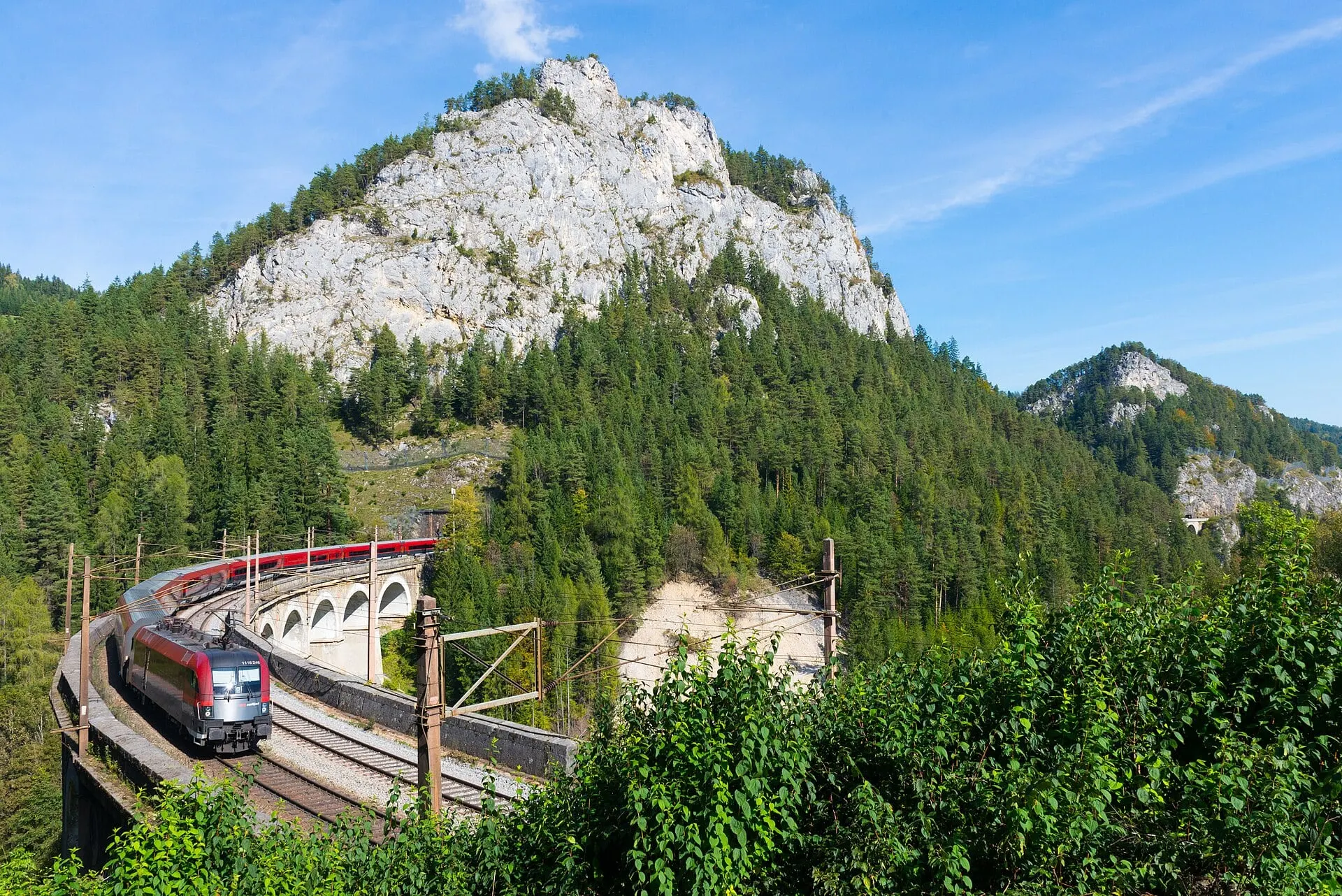
An ÖBB Railjet curving across the Kalte Rinne viaduct below the limestone Polleroswand on the Semmering Railway

TrainWinterAutumn

Vienna to Graz over the Semmering Railway

Europe's first mountain railway, still on the main line: viaducts stacked two high and a summit at 895 m.

The short answer

Vienna to Graz takes 2 h 26 min to 2 h 36 min, with 33 direct ÖBB trains a day in each direction in ÖBB's 2026 and 2027 timetables, and until the Semmering Base Tunnel opens in December 2029 every one of them crosses the Semmering Railway. A second-class Standard-Ticket bought online costs from €41.70 on ÖBB's fare table valid from 14 December 2025 (read 19 October 2026); there is no scenic supplement and no compulsory reservation, and ÖBB's limited Sparschiene fares within Austria start at €9.90. WESTbahn, a separate company with its own tickets, adds five trains a day in 2 h 29 min.

Less than an hour south of Vienna the ordinary intercity to Graz leaves the plain and starts to climb, looping along cliff faces, through tunnels blasted in the 1850s and across viaducts of stone and brick, up to a pass at 895 m. The Semmering Railway was the first railway line in the world to be listed by UNESCO, and it is still a working main line: you ride it on a normal ticket, with no supplement. Go soon: from December 2029 the fast trains are expected to take the new tunnel underneath.

Austria

Journey time
2 h 26 min to 2 h 36 min
Direct trains
33 ÖBB a day each way
Fare from
€41.70, 2nd class online
Mountain section
41 km over the pass
Highest point
895 m
UNESCO World Heritage
since 1998

The line that taught trains to climb

In the 1840s there was a railway from Vienna to Gloggnitz and from Mürzzuschlag on towards Graz, and between them stood the Semmering. Carl Ghega, an engineer born in Venice, came back from a study trip to the United States and drew it as an adhesion railway, ordinary wheels on ordinary rails, on a route that would not fight the mountain but follow it, wrapping round the side valleys at an average gradient of 20 per thousand. In 1848, the year of revolution, the plans were approved partly to give Vienna's unemployed work, and more than 18,000 labourers from across the monarchy went up to the pass. Ghega was knighted in 1851, the year a competition was held to find locomotives strong enough for the climb. The line opened to passengers on 17 July 1854.

What they built is still in daily use: 41 km from Gloggnitz to Mürzzuschlag, 16 major viaducts, more than 100 smaller arched stone bridges, tunnels through the rock walls of the Adlitzgraben, and 57 two-storey attendants' houses, one roughly every 700 m. The railway also made a landscape. Viennese society followed it up the mountain, and Semmering became one of the first purpose-built Alpine resorts, its villas and grand hotels still looking down on the tracks.

In 1998 UNESCO inscribed it as the first railway on the World Heritage List, calling it one of the greatest feats of civil engineering of the pioneering age of railways. In 2017 the documents of its construction joined UNESCO's Memory of the World Register. ÖBB, which still runs some 180 trains a day over it, calls it the oldest mountain railway in the world.
Along the way

  1. Vienna
  2. after Wiener Neustadt, under an hour out of Vienna

    The climb begins at Gloggnitz

    At Gloggnitz, 436 m above sea level, the flat run south from Vienna ends and the heritage line begins. The track leaves the plain and runs west along the slopes of the Schwarza valley towards Payerbach, gaining height with every kilometre, the river dropping away below the left-hand windows.

  3. at Payerbach-Reichenau

    Schwarza viaduct and the turn back east

    At Payerbach the line crosses the Schwarza valley on its viaduct and then doubles back on the far slope, climbing past Küb and Eichberg with the valley it has just crossed spread out below. It is the first sign of Ghega's method: never attack the mountain head on, go round it.

  4. after the Klamm tunnel, beyond Klamm-Schottwien station

    Into the Adlitzgraben

    UNESCO marks the Klamm tunnel as the point where the railway reaches the Alpine terrain proper. The Wagnergraben, Gamperlgraben and Rumplergraben viaducts follow in quick succession, three of the masonry bridges ÖBB restored stone by stone in 2018 and 2019, under the eye of the monument authorities.

  5. between Klamm-Schottwien and Breitenstein, then on past Breitenstein

    The Weinzettelwand

    Here the line runs along the face of a rock wall, in and out of a chain of short tunnels and a gallery cut into the cliff, with daylight flashing between them and a long drop to the valley floor. The Weinzettelwand comes first; beyond Breitenstein station the Krauselklause and the Polleroswand follow, the most dramatic stretch of the route.

  6. a few minutes after Breitenstein station

    Kalte Rinne viaduct

    The two-storey viaduct over the Kalte Rinne is the emblem of the line: tiers of arches carried on a curve across a side ravine. The view of it from the 20-Schilling-Blick, a viewpoint on the railway trail, is the one that appeared on the back of the old Austrian 20-schilling note. Guardhouse number 167, beside the viaduct, holds the world's only museum devoted to Ghega.

  7. about 1 h 15 min from Vienna

    Semmering station and the summit tunnel

    Semmering station stands below the villas and hotels of the resort the railway created. Just beyond it the train enters the tunnel under the pass, at 895 m the highest point of the line; water seeping into the original 1,431 m bore put parts of it at risk of collapse, and a new tunnel of about 1,512 m was opened beside it in 1952. On the far side you are in Styria.

  8. about 15 minutes after Semmering

    Down to Mürzzuschlag

    The descent is gentler, along the slope of the Fröschnitz valley through Steinhaus and Spital am Semmering to Mürzzuschlag at 677 m, where the heritage section ends. Two old locomotive halls at the station hold the Südbahn Museum, on the Vienna to Trieste railway that the Semmering made possible. From here the train runs down the Mürz valley to Bruck and Graz.

  9. Graz

Which side to sit

Sit on the left going from Vienna to Graz, and on the right coming back. The railway is built into the hillside, and for almost the whole climb from Gloggnitz to Semmering, and for most of the descent to Mürzzuschlag, the ground falls away on the left of a southbound train: that is where the valleys, the viaducts seen across the curves and the drops below the Weinzettelwand are. On the right you mostly look at rock and forest. Railjet seats can be chosen on a seat map when you add a reservation, from €3.

Ways to do it

When to go

Tickets, fares and reservations

How much is the train from Vienna to Graz, and do I need a reservation?

ÖBB charges one fare for every one of its trains on the route, branded Railjet or not, and no scenic supplement. ÖBB's Standard-Ticket is priced by how and when you buy it: online or in the ÖBB app is cheapest, then the ticket machine, then the ticket office, with the highest price charged on board. Buying 15 days or more ahead lowers it a little. A Standard-Ticket is not tied to one train, is valid for two days between Vienna and Graz and allows a break of journey, which is what makes a stop at Semmering free. Sparschiene tickets are cheaper but tied to one train and non-refundable, and up to four children under 15 travel free with each adult on Sparschiene Austria. Reservations are optional; ÖBB advises them on busy days, and a bicycle on a Railjet needs one. WESTbahn trains use WESTbahn's own tickets, with a seat reservation included online.

Vienna to Graz, 2nd class online
€41.70 15 to 180 days ahead, €43.50 1 to 14 days ahead, €44.30 on the day (fare table valid from 14 December 2025)
Vienna to Graz, 1st class online
€81.30 to €86.40
Ticket office / on board, 2nd class
€54.80 / €60.70 on the day
With an ÖBB Vorteilscard, 2nd class online
€20.90 to €22.20
Vienna to Semmering, 2nd class online
€21.60 to €22.90
Sparschiene
from €9.90 2nd class, €19.90 1st class, within Austria; limited seats, bookable up to 180 days ahead
Seat reservation
from €3, or €1.50 with Vorteilscard Comfort

Stations and luggage

Where do the trains leave from, and what can I take?

Trains to Graz leave Wien Hbf, the main station, and call at Wien Meidling five minutes later; the long-distance trains use platforms 3 to 12, the CJX regional trains towards Payerbach platforms 1 and 2. In Graz they arrive at Graz Hbf. Luggage is free on ÖBB trains if it fits on the racks above or below your seat, up to 90 by 60 by 40 cm, and skis, pushchairs and folded bikes go free too. Wien Hbf and Graz Hbf have bookable lockers; ÖBB lists none at Semmering, so if you plan a stop with big bags, leave them at either end.

Vienna
Wien Hbf, then Wien Meidling 5 min later
Graz
Graz Hbf
Luggage allowance
free, each piece up to 90 x 60 x 40 cm
Lockers
Wien Hbf and Graz Hbf; none listed at Semmering
On board
Railjets have free wifi, a restaurant car, quiet and family zones

The Semmering Base Tunnel and the old line

When does the Semmering Base Tunnel open, and what happens to the scenic route?

ÖBB is boring a 27.3 km tunnel in two bores between Gloggnitz and Mürzzuschlag. Excavation finished on 29 November 2024, and in its newsletter of June 2026 ÖBB says the first trains will run through it in December 2029: the fastest will need 12 minutes for the tunnel, Vienna to Graz will drop by about 30 minutes to under two hours, and the purpose, in ÖBB's words, is to relieve the historic line. The mountain railway is not closing. ÖBB is finishing a full renovation of it, and Lower Austria's government said at the tunnel's breakthrough in January 2025 that the line will stay in use for local and excursion traffic, and that the weekend heritage trains run since 2019 will carry on after the tunnel opens.

Base tunnel length
27.3 km, two bores
First trains (ÖBB, June 2026)
December 2029
Time saved
about 30 minutes; Vienna to Graz under 2 hours
Old line after 2029
kept for regional and excursion trains

Making sure your train takes the mountain route

How do I make sure my train goes over the Semmering and not through the tunnel?

Until December 2029 there is nothing to check: every direct train between Vienna and Graz runs over the pass, so any ticket and any departure will do. From the tunnel's opening, ÖBB has not yet published which trains will take which route, but a train that stops at Payerbach-Reichenau, Breitenstein or Semmering can only be on the old line. The sure way is to look for those stops in the ÖBB timetable, or to change at Payerbach-Reichenau or Mürzzuschlag onto the R 91 stopping train or the weekend Semmering-Express, which exist to serve the mountain stations.

Until December 2029
every direct Vienna to Graz train crosses the Semmering
After that, look for stops at
Payerbach-Reichenau, Klamm-Schottwien, Breitenstein, Semmering
Trains that always use the old line
R 91 Payerbach-Reichenau to Mürzzuschlag; Semmering-Express at weekends

Worth knowing before you go

The journey in pictures

The Kalte Rinne and Krausel Klause viaducts below the Polleroswand near Breitenstein, with the Rax beyond
A Railjet crossing the Krausel Klause viaduct near Breitenstein into the Krausel tunnel
A Railjet coming out of the Rumpler tunnel on the Semmering Railway near Gloggnitz
The arches of the Schwarza viaduct of the Semmering Railway above houses in Payerbach
The Semmering Railway winding along a forested slope near Semmering, with the Schneeberg on the horizon

Questions people ask

Good questions about The Semmering Railway

How long is the train from Vienna to Graz?

2 h 26 min on the Railjet Xpress, which leaves Wien Hbf at 53 minutes past most hours, and 2 h 36 min on the trains at 24 minutes past. ÖBB runs 33 direct trains a day in each direction in its 2026 and 2027 timetables, from 05:24 to 23:24, every day and all year, and WESTbahn adds five more in 2 h 29 min. ÖBB expects the journey to drop below two hours when the Semmering Base Tunnel opens in December 2029.

Does the train from Vienna to Graz go over the Semmering Railway?

Yes. Until the Semmering Base Tunnel opens in December 2029, every direct train between Vienna and Graz climbs over the Semmering Railway between Gloggnitz and Mürzzuschlag, the UNESCO World Heritage line opened in 1854. You need no special train or ticket: an ordinary Railjet or Intercity on a Standard-Ticket from €41.70 in second class takes you across the viaducts and through the tunnels.

Which side should I sit on for the Semmering Railway?

On the left going south from Vienna to Graz, and on the right going north to Vienna. The line is cut into the hillside, and for nearly all of the climb from Gloggnitz to Semmering and most of the descent to Mürzzuschlag the valley drops away on the left of a southbound train. That side gives you the views down into the Adlitzgraben and across the curves to the viaducts. A reserved seat costs from €3 and can be picked on a seat map.

Is there a scenic train or supplement on the Semmering Railway?

No supplement is charged. The scenic train is the normal Railjet, Intercity or regional train, on a normal ÖBB ticket. At weekends ÖBB runs two morning trains named Semmering-Express from Wien Hbf to Mürzzuschlag that call at the mountain stations, but they are ordinary second-class regional trains at the ordinary fare.

Can I stop off at Semmering on a Vienna to Graz ticket?

Yes, on a Standard-Ticket. It is valid for two days between Vienna and Graz, on any ÖBB train, and allows a break of journey, so you can get off at Semmering, walk or eat, and take a later train on. One Railjet every two hours stops at Semmering in each direction, and the R 91 stopping train runs every two hours too. WESTbahn trains also call there, but on their own tickets. Sparschiene tickets are tied to one train and do not allow this.

When does the Semmering Base Tunnel open, and will the old line close?

ÖBB says the first trains will run through the 27.3 km tunnel in December 2029, after excavation finished in November 2024. The historic line will not close: ÖBB is completing its renovation, and Lower Austria's government has said it will keep regional and excursion trains, including the weekend heritage trains that have run since 2019. The fastest Vienna to Graz trains are expected to move into the tunnel.

Is the Semmering Railway worth doing in winter?

Yes. The trains run on the same timetable all year, 33 direct ÖBB trains a day, and the line climbs to 895 m, high enough for the viaducts and forest to carry snow in a cold spell. Semmering is a small winter resort, with skiing on the Hirschenkogel, a 3 km toboggan run and cross-country trails when there is natural snow, so a stop there makes a day out from Vienna or a pause on the way to Graz.

The Semmering Railway

Europe's first mountain railway, still on the main line: viaducts stacked two high and a summit at 895 m.

Vienna → Graz

We may earn a commission when you book through Omio. It never changes what we write. · Last checked: October 2026

More train journeys

All the train journeys

Image credits: Liberaler Humanist (CC BY-SA 4.0) · Häferl (CC BY-SA 3.0 at) · Haeferl (CC BY-SA 3.0 at) · User:Karl Gruber (CC BY-SA 4.0)

Vienna → Graz

Book this journey

Check times and prices