Skip to content
The Better Trip

Destinations

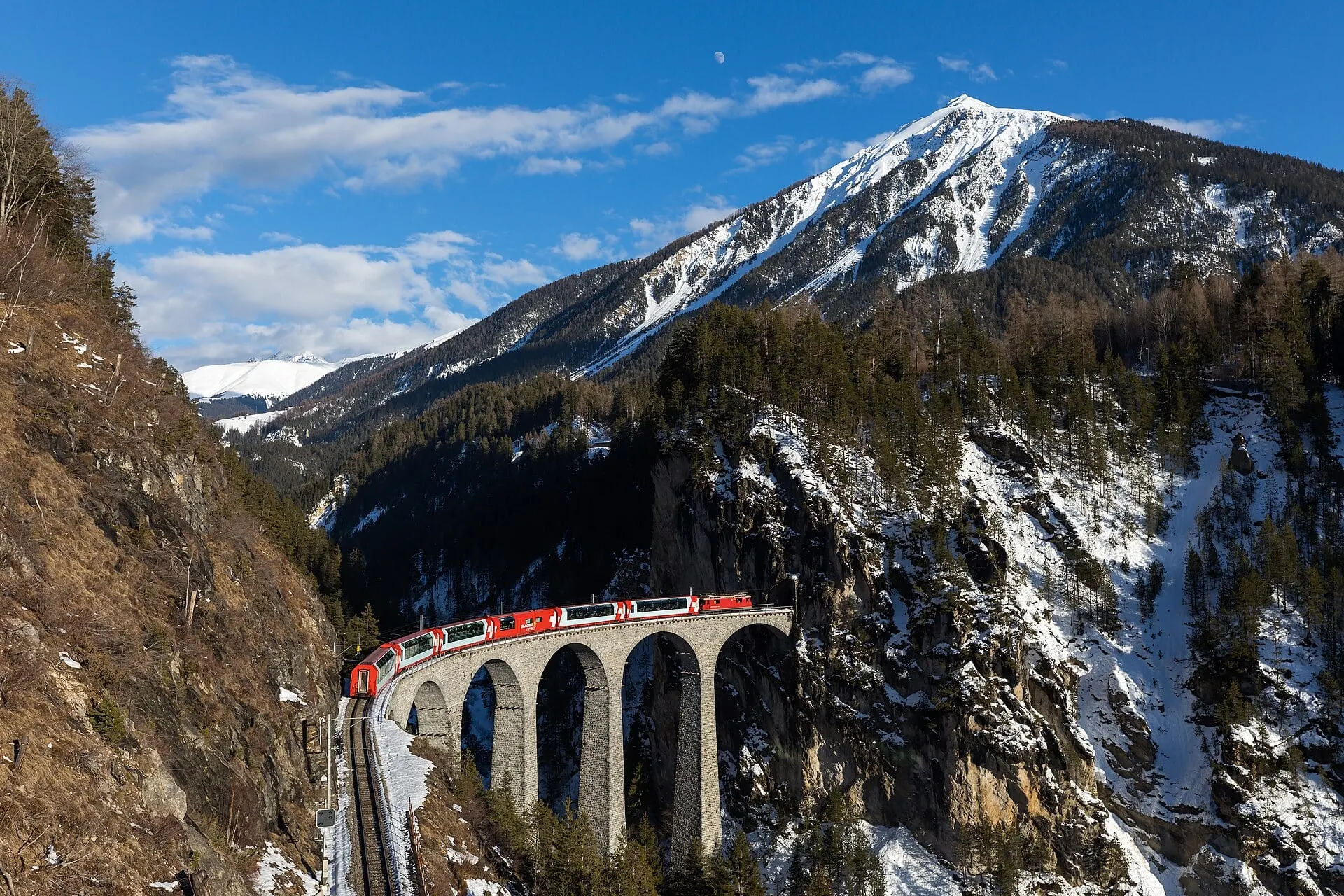
The Glacier Express crossing the Landwasser Viaduct under a snow capped peak and blue sky

TrainWinterSummer

Zermatt to St. Moritz on the Glacier Express

Eight hours, one narrow-gauge line, from the Matterhorn's valley over the Oberalp to the lakes of the Engadin.

The short answer

The Glacier Express takes 7 hours 47 minutes from Zermatt to St. Moritz and 8 hours 26 minutes the other way on the 2026/27 timetable, with one or two through trains a day each way in winter and two in summer. On 19 October 2026 the full second-class fare was CHF 166 plus a compulsory CHF 54 seat reservation, CHF 220 in all; first class comes to CHF 338 and Excellence Class to CHF 874. Seats are released 93 days before travel, and the train does not run between 11 October and 4 December 2026. Ordinary regional trains run the same line every hour, with four changes and no reservation.

The Glacier Express joins Zermatt, under the Matterhorn, to St. Moritz in the Engadin the long way round: 291 km of metre-gauge track, 291 bridges and 91 tunnels, over the Oberalp Pass at 2,033 m and down through the white cliffs of the Rhine Gorge. It ends on the Albula line, a UNESCO World Heritage railway that loops through spiral tunnels and crosses the Landwasser Viaduct straight into a rock face. You sit under windows that curve into the roof, lunch can be brought to your table, and the Alps go past for a whole day.

Switzerland

Journey time
7 h 47 min from Zermatt
Distance
291 km, 291 bridges
Highest point
Oberalp Pass, 2,033 m
Through trains a day
1 to 2 winter, 2 summer
Fare from
CHF 220 with the seat
Season
5 Dec 2026 to 9 Oct 2027

Why the slowest express in the world is worth a whole day

In the early twentieth century Zermatt and St. Moritz became cosmopolitan resorts, and in 1930 the railways that served them agreed to run a train between the two. The first Glacier Express left Zermatt on 25 June 1930, with saloon cars and a dining car. For half a century it ran only in summer, because snow and avalanches closed the line over the Furka each autumn. The Furka Base Tunnel, opened on 26 June 1982, made it a train for every season.

The line is metre gauge from end to end, and it climbs where a main line would tunnel. Its average speed is 42 km/h and its steepest gradient 12.5%, which is how a journey of 291 km comes to take most of a day, and why the operator still quotes the old nickname, the slowest express train in the world. In the 1980s it took to serving wine in a glass with a slanted stem, so the drink stays level on the climbs.

The finest engineering comes last. The Albula line, opened in 1903, through to St. Moritz in 1904 and a UNESCO World Heritage Site since 2008, lifts the train 1,078 m between Thusis and St. Moritz over 61.67 km of track, by way of 144 bridges and 42 tunnels and without a metre of rack. Its builders gained the height by turning the line back on itself in spiral and helical tunnels above Bergün, and by throwing the Landwasser Viaduct across a gorge into a cliff. Since 1993 the trains have had windows glazed up into the roof, so you see the mountains to their summits.
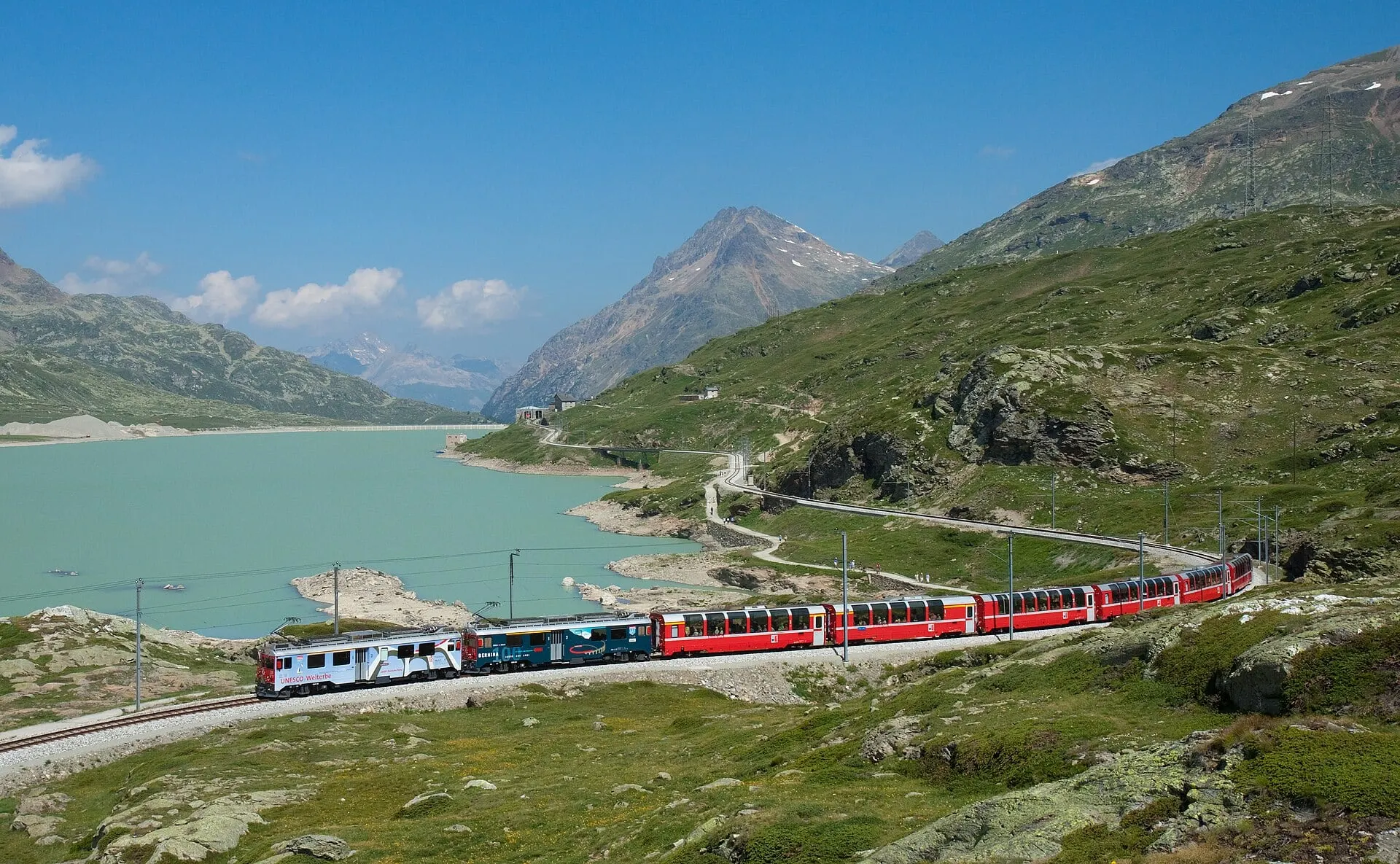
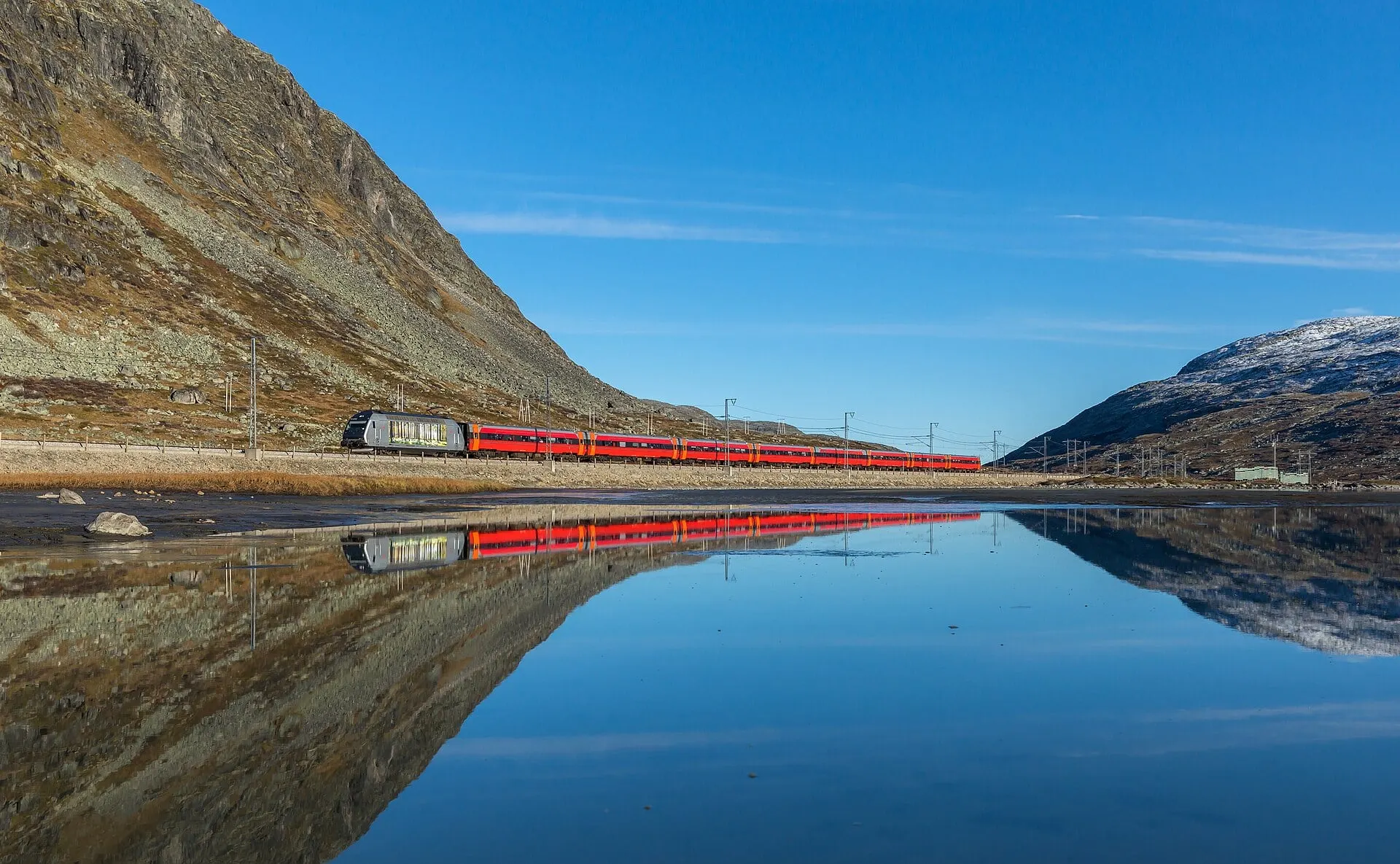
Along the way

  1. Zermatt
  2. about 10 minutes after Zermatt, then near Kalpetran

    The Bis Glacier and the Kipfen Gorge

    Running down the Matter valley, the Bis Glacier appears on the left in the direction of travel, hanging about 3.5 km long above the village of Randa on the eastern flank of the Weisshorn. Further down, near Kalpetran, the line squeezes through the Kipfen Gorge beside the Vispa, behind a wall built to hold back the floods and avalanches that once damaged the track.

  3. after Brig, between Oberwald and Realp

    The Goms and the Furka Base Tunnel

    Above Brig the train climbs the Goms, the high valley of the Upper Valais, past villages of sun-browned wooden houses and white church towers. At Oberwald it enters the Furka Base Tunnel, 15.4 km long and opened in 1982, which carries the line under the pass to Realp and made the Glacier Express a year-round train.

  4. between Andermatt and Disentis

    The Oberalp Pass

    From Andermatt, at 1,444 m, the line climbs to the Oberalp Pass at 2,033 m, the highest point of the journey. In winter the lake on the pass lies under a metre of snow; in summer cows graze its shore. By the water stands a lighthouse, a replica of the one at the mouth of the Rhine, put there because the river rises a little higher up at Lake Toma.

  5. at the foot of the Oberalp descent

    Disentis Abbey

    The descent ends at Disentis, the largest Romansh-speaking community in Switzerland, where a Benedictine abbey more than 1,400 years old stands over the village with its church of St. Martin. From here the train runs down the young Rhine towards Chur.

  6. between Ilanz and Reichenau

    The Rhine Gorge

    About 10,000 years ago the Flims landslide blocked the valley, and the Rhine has since cut its way back through the debris. The result is the Ruinaulta, a canyon of pale rock faces and pine forest with the turquoise river at the bottom, and the railway follows the river through it.

  7. just before Filisur

    The Landwasser Viaduct

    Built between 1901 and 1902 in a year and a half, the viaduct stands 65 m high and runs 142 m on six stone arches, curving across the Landwasser gorge before it enters a tunnel in the cliff. Its tall piers were raised without scaffolding. It is the image of the Albula line, and the Schmitten GR Landwasser Viaduct stop, five minutes' walk from a viewing platform, lets you see it from outside.

  8. after Filisur, before the Engadin

    Bergün to Preda and the Albula Tunnel

    Between Bergün and Preda the line gains more than 400 m with six high viaducts, three spiral tunnels and two helical tunnels. At Preda it enters the Albula Tunnel, a new 5.86 km bore in use since 2024 with its summit at 1,821 m, beside the original of 1903, and comes out in the Engadin for the last run past Samedan to St. Moritz.

  9. St. Moritz

Which side to sit on the Glacier Express

Heading from Zermatt to St. Moritz, sit on the left before Chur and on the right after it. The left gives you the Bis Glacier in the Matter valley and the river side of the Rhine Gorge, where the track runs along the south bank with the water below the left-hand windows. After Chur the right gives you the Landwasser Viaduct: the bridge curves to the right on its way into the cliff, so from the inside of the curve you watch the front of the train cross the arches and disappear into the rock. The happy accident is that the train reverses at Chur, so the same seat does both jobs: a seat on the river side in the gorge is on the viaduct side after Chur. Going the other way, reverse the advice. You cannot book a side or a direction, because the train changes direction on the way, so if you are two, book facing seats at a table. Every class has the same panoramic windows, and the windows in the entrance doors open for photographs without reflections.

Ways to do it

When to go

Tickets, reservations and passes

How do you book the Glacier Express, and is it covered by the Swiss Travel Pass?

A Glacier Express seat costs two things: a ticket for the route and a compulsory seat reservation. Tickets go on sale 180 days before travel; reservations for 1st and 2nd class 93 days before, and Excellence Class for the whole timetable period. Seats for the winter timetable from December go on sale from mid-October, and by the end of October at the latest. Book on the Glacier Express site, where you can pick the seat from a plan of the train, or at any staffed Swiss station.

A Swiss Travel Pass, Eurail or Interrail Pass, GA travelcard or Saver Day Pass covers the ticket, so you pay only the reservation; the Half Fare Card halves the ticket. First class and Excellence Class need a first-class ticket or pass. Children under 6 travel free but have no seat of their own unless you reserve one; from 6 to 16 they pay half the ticket and the full reservation. A reservation made online cannot be changed or cancelled, while the ticket can be bought separately and later. Upgrades are sold on board if seats are free.

Seat reservation, 1st or 2nd class
CHF 54, compulsory, not covered by passes
Seat reservation, Excellence Class
CHF 590, plus a 1st-class ticket or pass; includes the five-course menu and wines
Full fare, Zermatt to St. Moritz
CHF 166 in 2nd class, CHF 284 in 1st (19 October 2026)
Booking opens
tickets 180 days ahead; 1st and 2nd class seats 93 days ahead; Excellence for the whole timetable
Children
under 6 free without a seat; 6 to 16 half fare, full reservation
Changes
online reservations cannot be changed or cancelled

Luggage, food and the two ends

How much luggage can you take on the Glacier Express, and how do you reach Zermatt?

Space is tight. Racks at the end of each carriage take suitcases, and the operator asks for no more than one case besides hand luggage. Skis, golf bags, bicycles and oversized cases are not carried. For anything more, send it ahead: Jaisli Mobility Service collects from and delivers to any Swiss address by 18:00 on the day if booked by 17:00 the day before. Dogs are not allowed on board, except recognised assistance dogs.

Food is cooked on board and served at your seat; pay by card or Twint, as no cash is taken. Pre-order with your booking or up to 48 hours ahead. Zermatt has always been car-free: drivers park at Täsch and take the shuttle train, every 20 minutes and 12 minutes up the valley. St. Moritz station sits at about 1,800 m by its lake, two hours from Chur, and is also the start of the Bernina line to Tirano. Zurich Airport is the usual gateway, with trains to both ends.

Luggage
one case plus hand luggage; no skis, golf bags, bikes or oversized cases
On-board meals, 2026 menu
main course CHF 36; three courses CHF 49
Payment on board
cards and Twint only
Täsch to Zermatt shuttle
every 20 minutes, 12 minutes
Boarding points
Zermatt, Brig, Andermatt, Chur, Filisur (for Davos), Samedan, St. Moritz

The timetable, both ways

What time does the Glacier Express leave Zermatt and St. Moritz?

Eastbound trains take 7 hours 47 minutes and westbound ones 8 hours 26 minutes, so the shorter day is from Zermatt to St. Moritz. The through trains call at Brig, Andermatt, Disentis and Chur, where the train reverses before climbing to the Albula; heading east they also set down at Samedan, and at Filisur or Tiefencastel. Passengers to and from Davos change at Filisur.

Zermatt to St. Moritz, daily all season
08:50, arrives 16:37 (Excellence Class)
Zermatt to St. Moritz, extra train
07:50, arrives 15:37 (12 Dec to 3 Jan, 30 Jan to 7 May 2027)
Zermatt to St. Moritz, summer 2027
08:50 and 09:50, arrive 16:37 and 17:37
St. Moritz to Zermatt, daily all season
08:38, arrives 17:04 (Excellence Class)
St. Moritz to Zermatt, second train
09:38, arrives 18:04 (winter dates as above, daily in summer)
No Glacier Express
11 October to 4 December 2026; 10 October to 3 December 2027

Worth knowing before you go

The journey in pictures

Glacier Express panorama coaches on the stone arches of the Landwasser Viaduct beside the cliff tunnel
The Glacier Express climbing across green slopes towards the Oberalp Pass under a blue sky
The Glacier Express running beside the Rhine below the pale cliffs of the Rhine Gorge
The Glacier Express curving above the Rhine near Versam
Glacier Express coaches at Oberalppass station beside the Oberalpsee lake
A Glacier Express panorama coach at Brig station

Questions people ask

Good questions about The Glacier Express

How long is the Glacier Express from Zermatt to St. Moritz?

7 hours 47 minutes eastbound on the 2026/27 timetable: the 08:50 from Zermatt reaches St. Moritz at 16:37. The return takes 8 hours 26 minutes, leaving St. Moritz at 08:38 and reaching Zermatt at 17:04, because of longer stops on the way. The train covers 291 km at an average of 42 km/h.

How much does the Glacier Express cost?

On 19 October 2026 the full fare from Zermatt to St. Moritz was CHF 166 in second class and CHF 284 in first, plus a compulsory seat reservation of CHF 54, so CHF 220 or CHF 338 in all. Excellence Class needs a first-class ticket and a CHF 590 reservation, CHF 874 in all, which includes a five-course menu with wines. Meals in the other classes are extra.

Is the Glacier Express free with the Swiss Travel Pass?

The pass covers the ticket but not the seat reservation, which every passenger needs: CHF 54 in first or second class, CHF 590 in Excellence Class. First class and Excellence Class need a first-class pass. Eurail and Interrail passes work the same way. On the regional trains that run the same line, the pass covers everything and no reservation is needed.

Can you do the Glacier Express route without a reservation?

Yes, on ordinary regional trains over the same track. Change at Visp, Andermatt, Disentis and Reichenau-Tamins; the trip takes about 8 hours 20 minutes, and on 15 December 2026 trains left Zermatt every hour from 05:35 to 14:33. You see the Oberalp, the Rhine Gorge and the Landwasser Viaduct without the panoramic carriages and with no meal service, for the ticket alone. Ask for a route via Andermatt, or the planner will send you through Zurich.

Which side of the Glacier Express is best?

From Zermatt, the left side until Chur for the Bis Glacier and the river in the Rhine Gorge, then the right side for the Landwasser Viaduct. The train reverses at Chur, so one seat on the river side covers both. Seats cannot be booked by side or direction, so couples should take facing seats. All classes have the same panoramic windows.

Is Glacier Express Excellence Class worth it?

It buys a guaranteed window seat at a table for two in a carriage of 20, a concierge, luggage taken from you on the platform, champagne, a five-course menu cooked on board with matched wines, and the Glacier Bar. The views are the same as in first class. It runs once a day each way and costs CHF 590 on top of a first-class ticket or pass.

Does the Glacier Express run in winter?

Yes. Since the Furka Base Tunnel opened in 1982 it has run all year except for an autumn break, from 11 October to 4 December 2026. The winter timetable runs from 5 December 2026 to 7 May 2027 with one train a day each way, and a second on most dates from 12 December, over the snowbound Oberalp Pass at 2,033 m.

The Glacier Express

Eight hours, one narrow-gauge line, from the Matterhorn's valley over the Oberalp to the lakes of the Engadin.

Zermatt → St. Moritz

We may earn a commission when you book through Omio. It never changes what we write.

More train journeys

All the train journeys

Image credits: Kabelleger / David Gubler (CC BY-SA 4.0) · Böhringer Friedrich (CC BY-SA 3.0 at) · Jakkes (CC BY-SA 3.0) · Kabelleger / David Gubler (Public domain) · Hansueli Krapf (CC BY-SA 3.0) · Gio 2000 (Public domain) · Whgler (CC BY-SA 4.0)

Zermatt → St. Moritz

Book this journey

Check times and prices