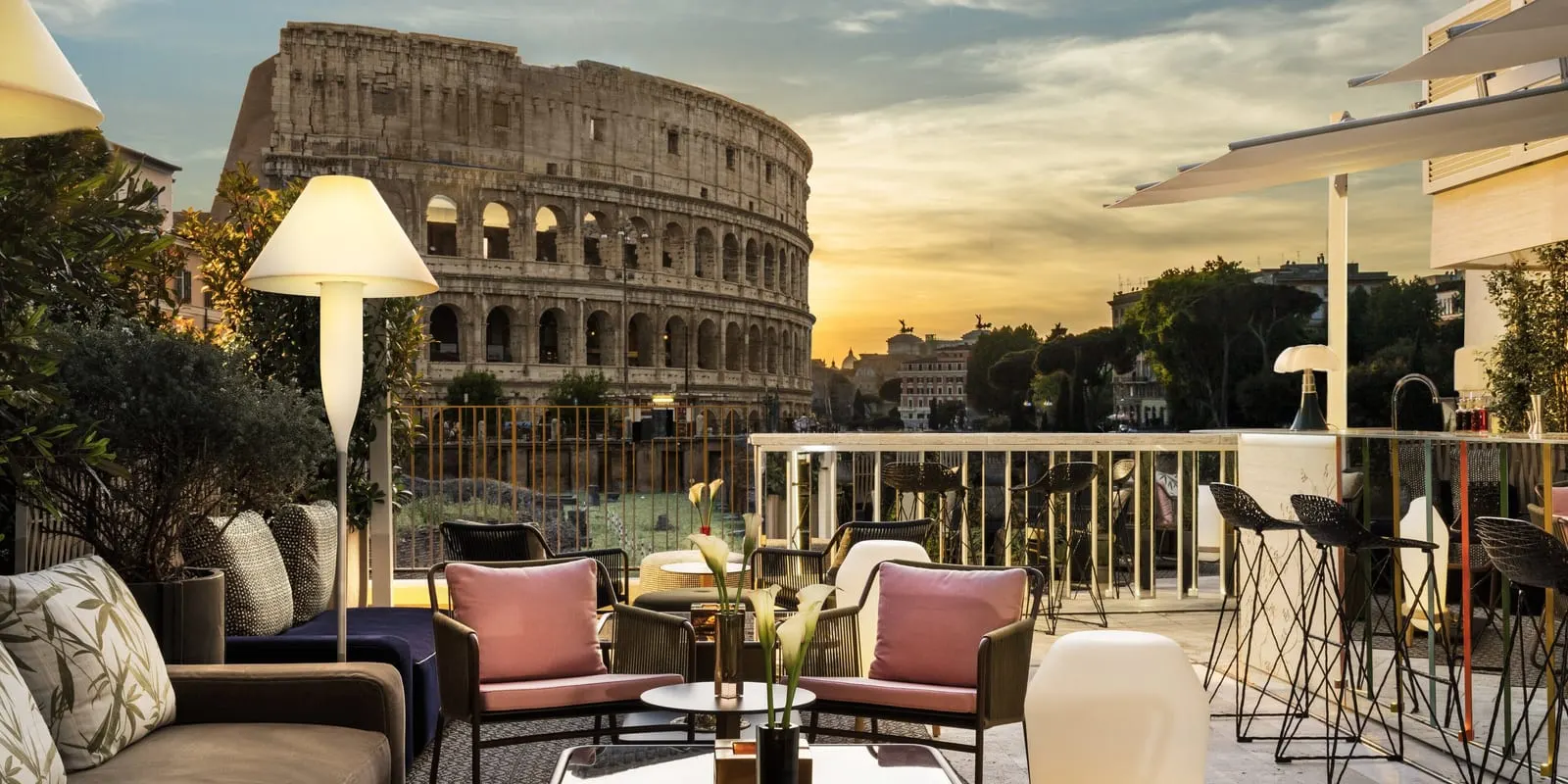
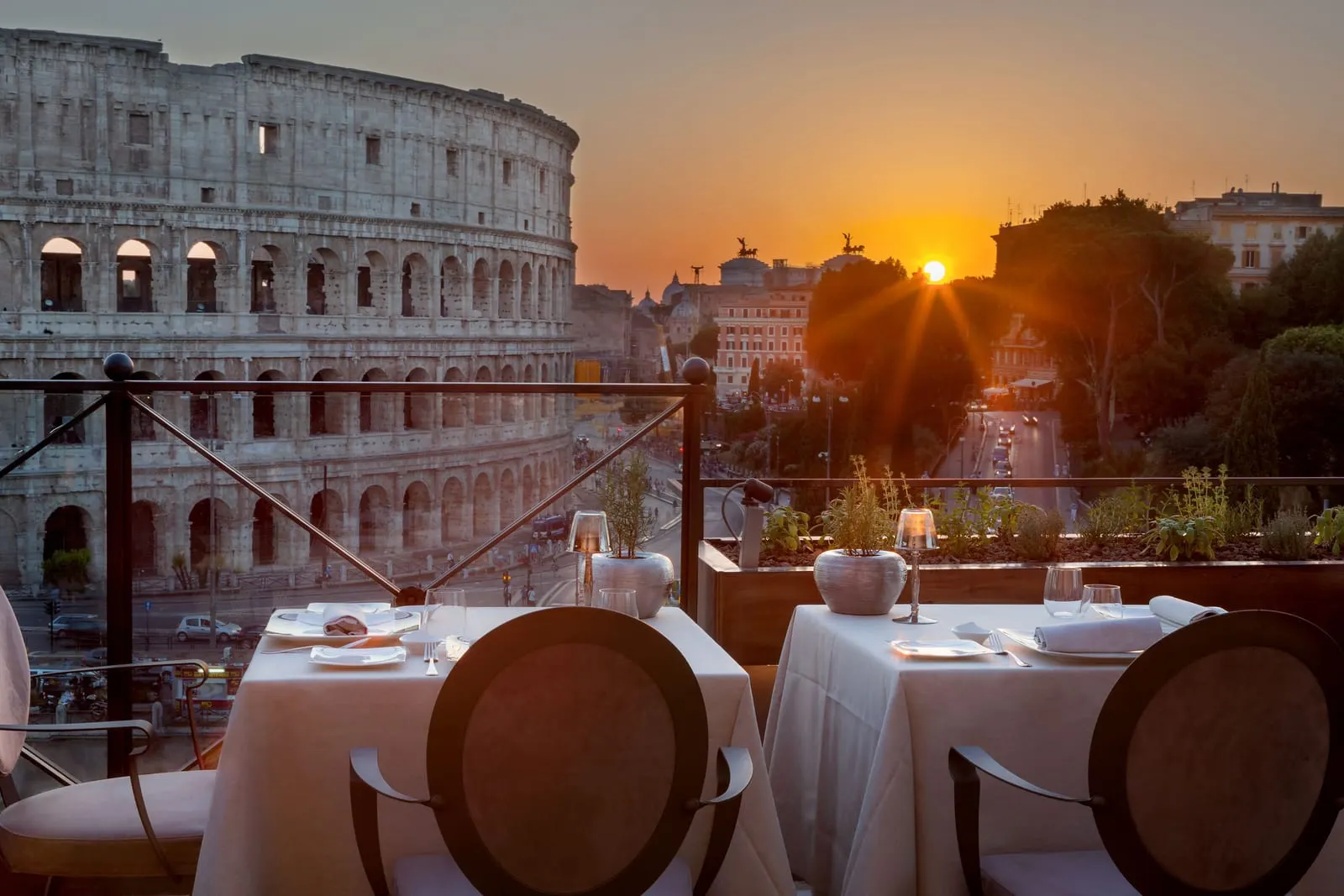
The palazzo was built for the Evangelisti family in the early 17th century to a design by Giovanni Battista Mola, sold on to the Venerable Confraternity of the Holy Trinity of the Pilgrims and Convalescents, whose purchase two facade plaques still record, and remodelled in the 18th century as a hunting lodge for the Guidi family. Count Goffredo Manfredi bought it in 2002; the hotel publishes no opening year, and the 2003 date comes from its Expedia property record. A loggia at the top carries Cicero's motto Virtute duce, comite fortuna. The building is tiny: OpenStreetMap's footprint measures roughly 18 metres by 22, over four levels, and its west flank gives straight onto the excavated Ludus Magnus, the gladiators' training ground, and the nearest arches of the Colosseum about 190 metres beyond, across the excavation and Via Labicana. Be accurate about that view: the hotel's own word for it is panoramic, not close. From the Aroma terrace, four levels up on ground already some eight metres above the Colosseum's, your eye lands around the second order of arcades, roughly halfway up a monument that rises 48.5 metres, so you look across at the arcades and up at the attic. The Ludus Magnus below is a view rather than a visit: the Sovrintendenza Capitolina has kept it closed to the public since 1 August 2024 for a 3.5 million euro restoration, and it was not among the nine sites the Caput Mundi programme reopened in June 2026.
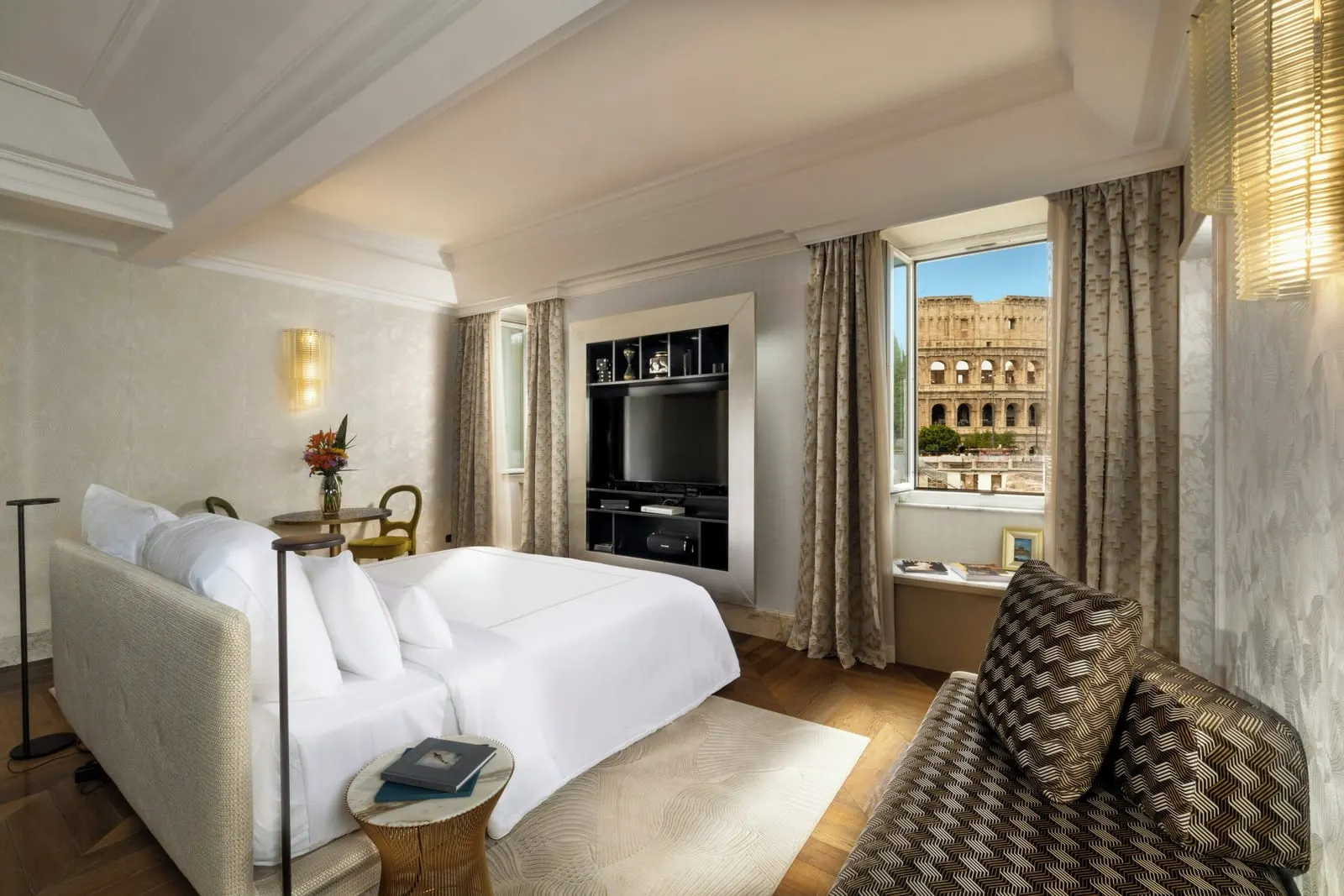
Twenty-four keys across two buildings. The palazzo holds twelve rooms and, by the hotel's count, three suites, though the booking engine sells four; nine Grand View Suites occupy the residence next door, an orthogonal travertine mesh by Matteo Thun completed in 2018, with interiors by Giorgia Dennerlein of Loto Ad Project, whose own record describes five suites there, not nine. In the palazzo itself the three room categories are small and unequal. The Prestige is 25 square metres and faces the inner courtyard, the Executive is 27 and faces the Colle Oppio park, and the Master is 25 again, on the second and third floors, and the only one of the three with the amphitheatre in the window and a shower pointed at it. Suites climb from the 60 square metre Colosseo and Ludus Magnus to the 150 square metre Grand View Penthouse. A bath facing the amphitheatre exists in one category only, the 120 square metre Grand View Suite Colosseo, sold on a jacuzzi bath with Colosseum views at 2,289 euros a night on the February probe.
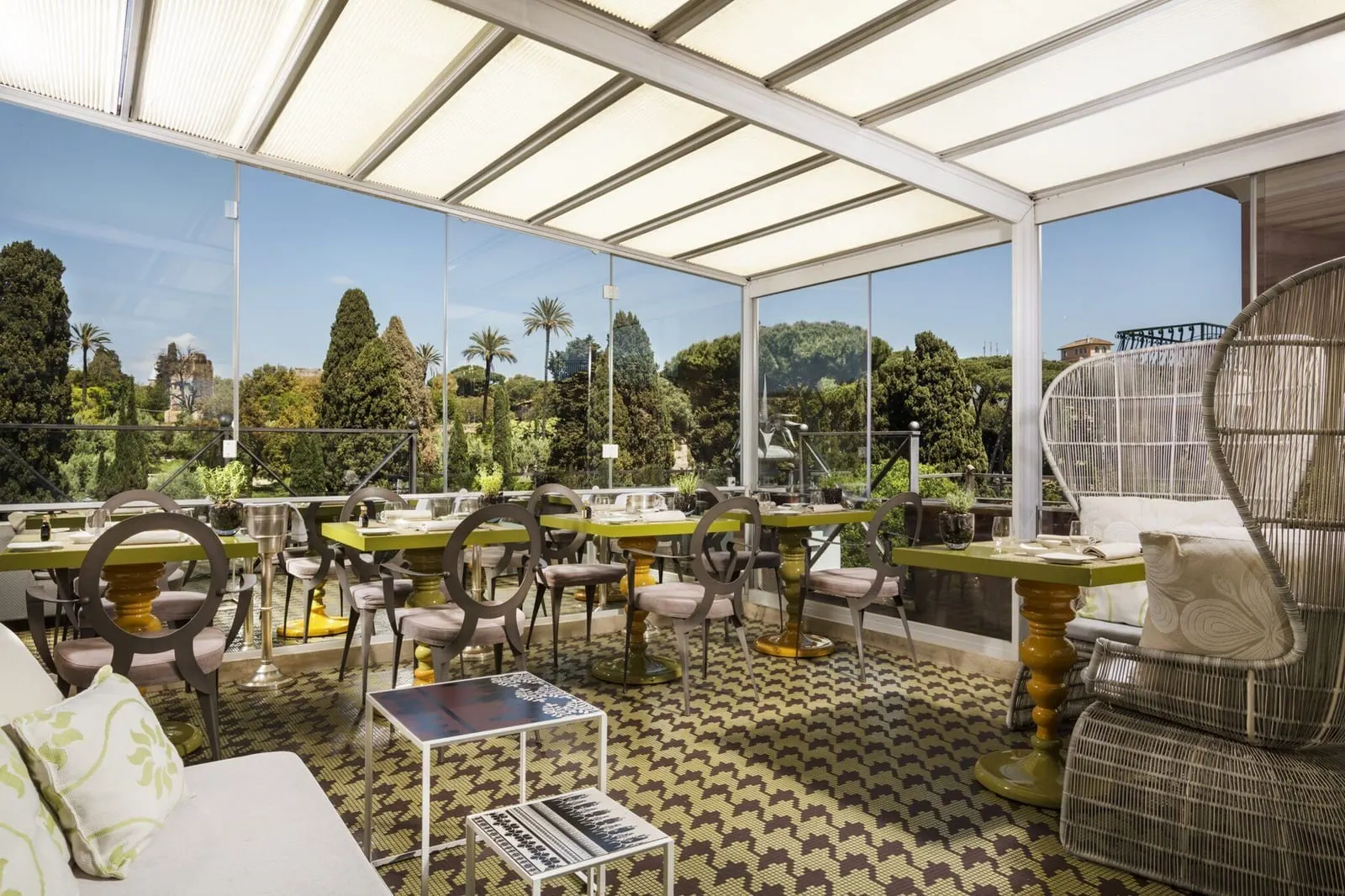
Aroma is on the roof, reached by lift, and holds one star in the 2026 MICHELIN Guide Italia under Giuseppe Di Iorio. The summer 2026 list ran four tasting menus, 270 euros for the Corinzio down to 190 for the vegetarian Colle Oppio, with a shorter Smart Menu at 180 and pairings from 120. The Michelin inspector notes the terrace is enclosed and covered in winter, so it works in any month, with the Domus Aurea to the right and the dome of St Peter's beyond. Breakfast for every guest is served up there, whatever the rate. The Court, wedged between the two buildings and set above the Ludus Magnus, is Matteo Zed's cocktail bar, open 18:00 to 01:30, with an entry minimum of two creations at 60 euros a head on the current printed list and 55 on the website. There is no spa, no pool and no wellness page on the site; the gym over the Ludus Magnus appears only on the SLH and Expedia listings.
Book it for the window rather than the floor area, and know what the address costs you. Via Labicana carries buses, trams and scooters, guests report thin soundproofing, and the weakest Tripadvisor subscores across 767 reviews are value at 4.2 and sleep quality at 4.5. A starred restaurant and a reservation-only bar bring non-residents through the same entrance every evening. If you want a garden, a spa and space to spread out, Hotel de Russie has all three. For a rooftop over ruins at a good deal less, 47 Boutique Hotel faces the Forum Boarium. If a landmark in the window is the point but the rate is not, Albergo del Senato faces the Pantheon's portico.